Employee Empowerment: Giving Authority Without Losing Control

Every owner says he wants his people to take ownership. Then the sales manager offers a customer 8% instead of 5%, and the owner reverses it by phone in front of the customer. The team learns the real rule in one afternoon.
Employee empowerment is giving people the authority, information, resources and confidence to make decisions and act within their role without waiting for approval. In practice it has two parts: structural empowerment, the actual authority and access the company grants, and psychological empowerment, whether the person experiences their work as meaningful, feels competent, has real choice, and believes their work has impact. Companies that talk about empowerment usually mean the second and have not done the first.
This page gives the concept, the two halves, the reasons it fails in owner-run companies, and how to give authority without losing control.
What empowerment means
The word has been worn smooth by posters. The concept underneath is precise.
Rosabeth Moss Kanter's structural view: empowerment is access to information, resources, support and opportunity. A person who has all four can act; a person missing any of them cannot, however motivated. Gretchen Spreitzer's psychological view: empowerment is experienced as four things, meaning (the work matters to me), competence (I can do it), self-determination (I have choice in how), and impact (what I do changes the outcome).
The two are linked in one direction. Structural empowerment produces psychological empowerment over time. Psychological empowerment without structural empowerment produces frustration, because the person feels capable and has no authority to act on it.
Empowerment versus delegation versus abdication
Three things that get confused.
Delegation is a manager handing a specific task and its authority to a specific person. The delegation of authority spoke covers it. Empowerment is broader: a standing grant of authority within a role, so that the person does not need a delegation for each decision. And abdication is granting the authority without the information, resources, limits or support that make it usable, then blaming the person when it goes wrong.
Most SME "empowerment" initiatives are abdication. A manager is told to take ownership, given no written limits, no access to the numbers, and no cover when a decision is questioned. He takes ownership once, it is reversed, and the initiative is over.
Why empowerment fails in owner-run companies
The authority was never written down. "Use your judgement" is not authority. A discount limit, a purchase approval value, a hiring budget is. Without the number, every decision is a guess about what the owner would have done, and the safe guess is to ask. The authority matrix is the one-page fix.
The information stays with the owner. The manager can decide on the discount but cannot see the margin. He can approve the purchase but does not know the cash position. Empowerment without information is a request to decide blind.
The first mistake is reversed in public. A decision within the limit that goes wrong is overturned the same day, usually in front of the team. One reversal ends the empowerment, because the lesson is that the authority is conditional on getting it right, which means it is not authority.
The owner answers the question anyway. The manager has the authority. He asks the owner "just to confirm". The owner answers. The authority has quietly returned. The owner has to refuse below the line, every time, for about a month, and most do not.
The family exemption. Non-family managers are empowered on paper; family members can overrule them in practice. Everyone knows, and the paper is decoration.
Giving authority without losing control
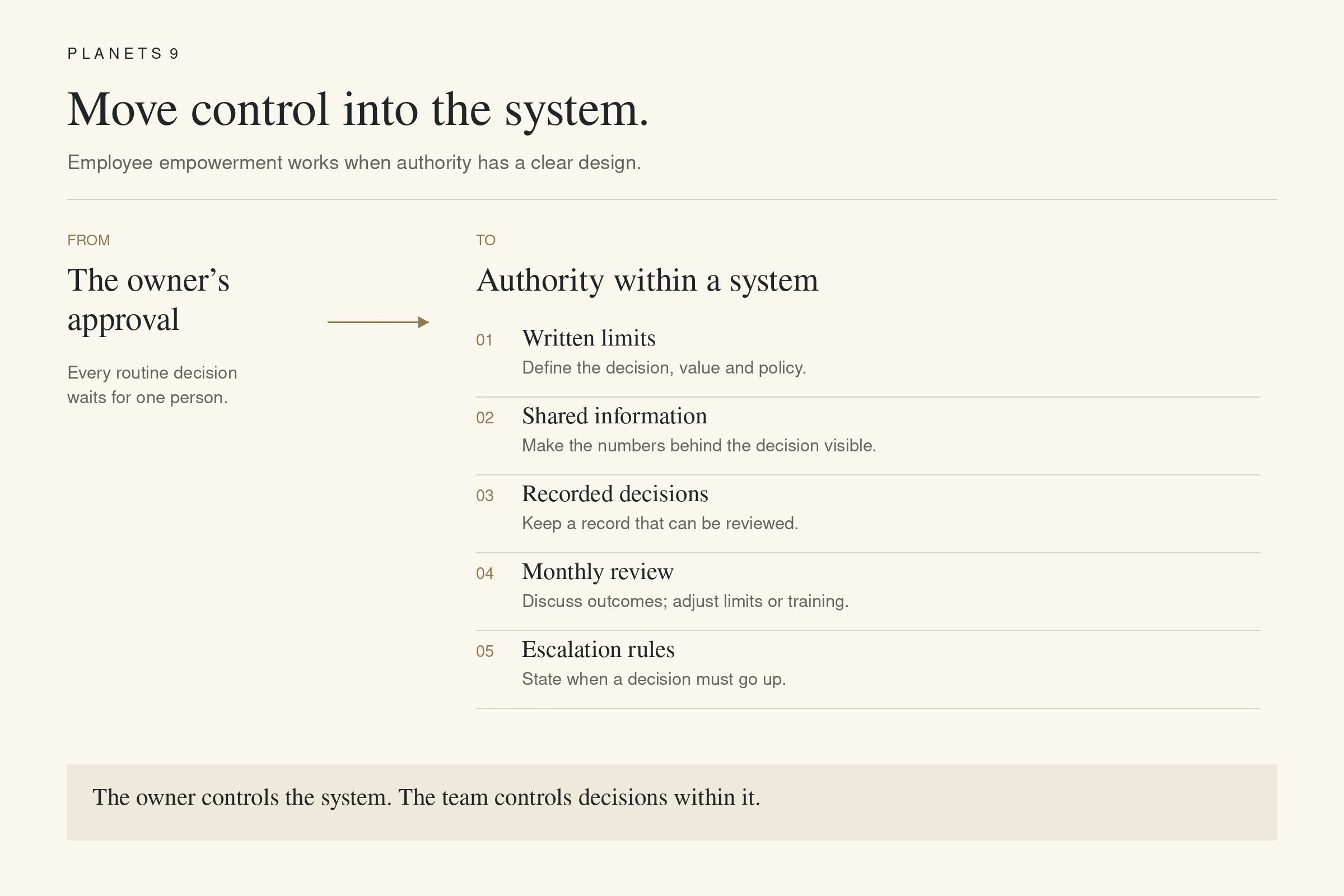
The fear underneath every owner's hesitation is that empowerment means losing control. The design that works keeps control and moves it from the decision to the system.
Limits, in writing. Authority is bounded: this decision, up to this value, within this policy. Control lives in the limit, not in the approval.
Information, shared. The numbers a decision depends on are visible to the person making it. A manager who can see margin will protect it better than one who cannot.
Records, kept. Every decision within the limit is recorded, so it can be reviewed. Control lives in the review, not in the pre-approval.
Review, not reversal. Decisions are looked at monthly, as decisions. A bad one is discussed and the limit or the training adjusted. It is not overturned the same afternoon.
Escalation rules. Above the limit, or in defined situations (legal threat, key customer, safety), the decision goes up. The rule is written so escalation is a rule and not a reflex.
Under this design the owner controls the system and the people control the decisions. The SOP examples show what the limits look like written into procedures.
What empowerment produces
Where it holds, three things change. Decisions are made at the speed of the work rather than the speed of the owner's inbox. Managers grow, because judgement develops only by exercising it. And the owner gets back the hours that were spent answering questions that had answers.
Where it holds also depends on who was empowered, which is the part of the subject that gets the least attention.
The person the authority is given to
Structural empowerment can be designed. Whether the person will use it cannot. Some people receive authority and use it fully from the first week. Some receive the same authority and hand it back by asking, not from incompetence, but from how they are built to relate to risk and to the owner. A few use it recklessly. The same one-page matrix produces three companies depending on who holds each seat.
That is the layer under the design. The Business Pulse reads how your organisation actually runs, where decisions form, where they stall, and how much still routes through you, and is the instrument for seeing where authority granted on paper is actually being held.
Questions people ask about employee empowerment
What is employee empowerment?
Giving people the authority, information, resources and confidence to make decisions and act within their role without waiting for approval. It has a structural half (the authority actually granted) and a psychological half (the person's sense of meaning, competence, choice and impact).
What are the objectives of employee empowerment?
Faster decisions at the level closest to the work, managers who develop judgement by exercising it, higher engagement and retention, and a company that does not depend on one person's approval for routine decisions.
What is the difference between delegation and empowerment?
Delegation hands a specific task and its authority to a specific person. Empowerment is a standing grant of authority within a role, so the person decides without a fresh delegation each time.
What are examples of employee empowerment?
A sales manager who approves discounts up to 10% and records them; a purchase executive who selects from an approved vendor list up to ₹2 lakh; a service coordinator who offers a replacement under ₹10,000 without asking. Each with the numbers visible and the decisions reviewed monthly.
Why does employee empowerment fail?
Unwritten authority, information kept at the top, the first mistake reversed in public, the owner answering questions he should refuse, and family members who can overrule empowered managers.
How do you empower employees without losing control?
Move control from the approval to the system: written limits, shared information, recorded decisions, monthly review instead of same-day reversal, and written escalation rules.
Where to go deeper
Organisational Development — the whole discipline.
Delegation of Authority — the act, and why it comes back.
Authority and Responsibility — the one-page matrix.
Employee Engagement — the will, where this page is about the means.
Owner Dependency: Why Your Business Can't Run Without You — the pattern empowerment is meant to break.