Delegation of Authority: The Three Elements, Why It Comes Back, and the Handover That Holds

The owner delegates the purchase function to the new manager on a Monday. On Wednesday the manager asks whether he should go with the usual vendor. On Friday the owner is approving purchase orders again and has concluded that delegation does not work with this team. The authority went out and came back in five days.
Delegation of authority is the process by which a manager assigns part of his work to a subordinate, grants the authority needed to do it, and creates an obligation on the subordinate to account for the result. It has three elements: assignment of responsibility, grant of authority, and creation of accountability. Authority can be delegated; ultimate accountability cannot, and remains with the manager who delegated. The textbook version stops there. The owner-run version is about why the authority comes back.
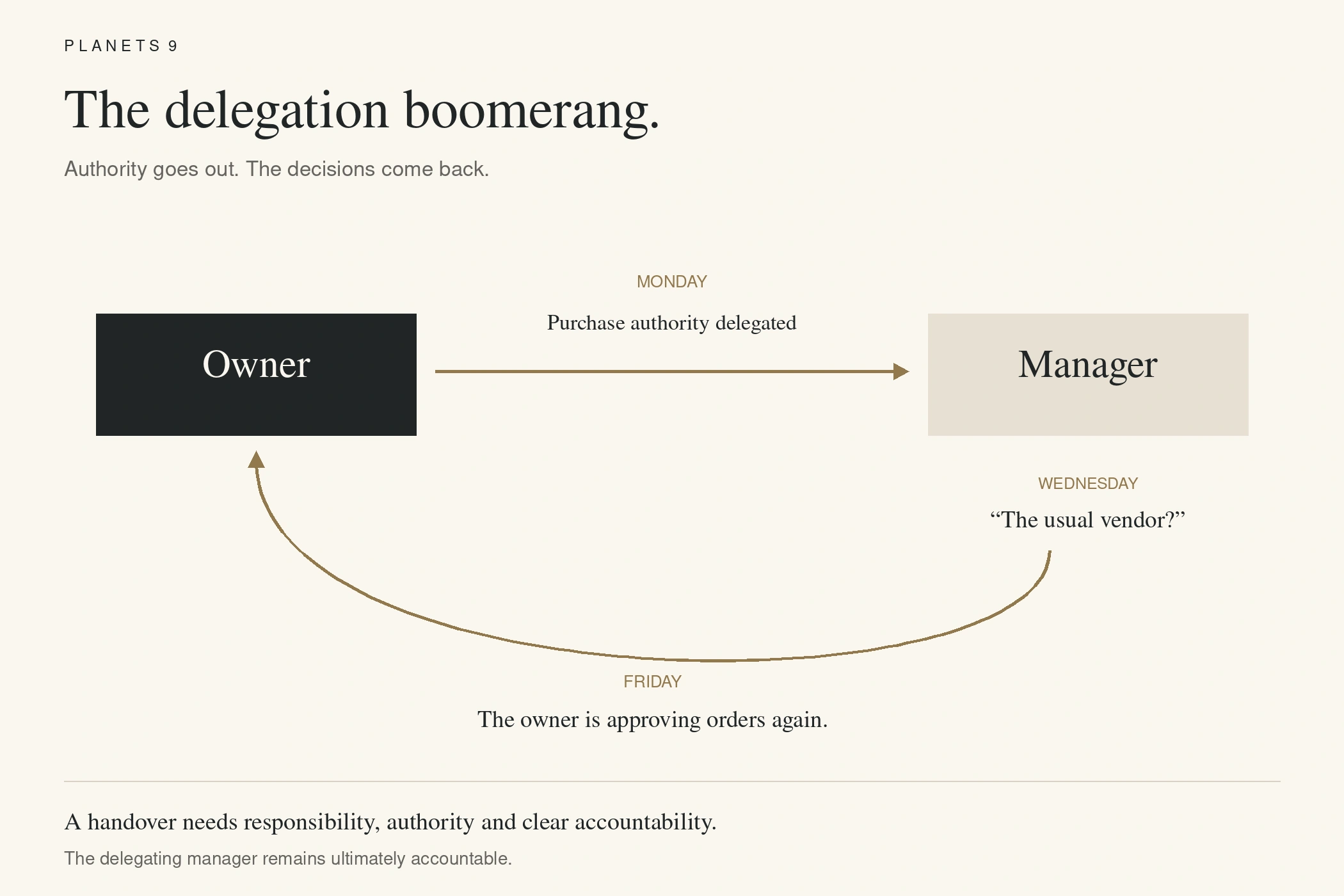
This page gives the three elements, the reasons delegation fails from both sides, and the handover that holds.
The three elements
Assignment of responsibility. The manager defines the task or function and the result expected: not "look after purchase" but "ensure every purchase above ₹5,000 is on an approved PO with quotes as per policy, and monthly purchase cost stays within budget".
Grant of authority. The manager gives the subordinate the right to make the decisions the task requires: approve POs up to a limit, select vendors from the approved list, negotiate terms within policy. Without this element, the subordinate has responsibility and no means; the authority and responsibility spoke is about that mismatch.
Creation of accountability. The subordinate becomes answerable to the manager for the result, through defined reporting: a monthly purchase summary, exceptions flagged within a day. The manager remains answerable to his own superior. Accountability flows up; it does not transfer.
The three have to move together. Responsibility without authority produces a manager who asks. Authority without accountability produces a manager nobody checks. Either alone is not delegation, it is a title.
Why delegation fails: the owner's side
Four reasons, and owners recognise all of them.
"It is faster to do it myself." True, the first fifty times. The fifty-first time the owner is still doing it, and the manager has learned it is not his.
Fear of the mistake. The manager will get one wrong. The owner reverses it in public. The manager never uses the authority again. One reversal costs the whole delegation.
Not letting go of the knowledge. The owner delegates the task and keeps the vendor relationships, the pricing logic and the history in his head. The manager cannot do the task without asking, so he asks, and the owner concludes the manager cannot do the task.
Delegating the task and keeping the decision. "Handle purchase, but check with me before you commit." That is not delegation. It is assigning the work and retaining the authority, and it is the most common form in Indian SMEs.
Why delegation fails: the manager's side
Fayol wrote that responsibility is "generally feared as much as authority is sought". Some managers receive authority and do not use it. Not from incompetence; from how they are built to relate to risk, to the owner, and to being answerable. They ask "just to confirm", and each confirmation returns the decision to the owner.
Others use it immediately and fully, and a few use it recklessly. The same grant of authority produces three outcomes depending on who receives it, and the document that granted it looks identical in all three cases.
This is the failure delegation guides do not cover, because it is not about the process. It is about the fit between the authority and the person, and the owner usually discovers it after the boomerang, when it is expensive.
The handover that holds
Five conditions. Companies that have made delegation stick did all five; companies where it came back usually skipped two.
Write the authority down, with a number. "Purchase approval up to ₹2 lakh within budget; above that, to the GM." A one-page authority matrix for the whole company, so the limit is a rule and not a favour.
Move the knowledge with the authority. The vendor list, the pricing logic, the history, in writing, before the handover. The SOP method is how.
Refuse below the line. When the manager asks "just to confirm" on a decision within his limit, the owner's answer is "that is yours". Every time. The first month is the hard one.
Review decisions, do not reverse them. A decision within the limit that turned out badly is discussed at the monthly review as a decision. It is not overturned the same afternoon. The owner's behaviour in that moment decides whether the delegation survives.
Choose the person for the authority, not the title for the person. Before delegating, ask not "is he senior enough" but "does he hold authority without checking, and use it without recklessness". If the honest answer is no, the delegation will come back whatever the document says, and the fix is a different person, not a better document.
The how to delegate as a founder essay is the practical companion to this spoke.
Delegation and decentralisation
Delegation is an act between two people; decentralisation is the state of an organisation in which authority is systematically dispersed. A company can delegate constantly and remain centralised, if every delegation is personal, ad hoc and reversible. Fayol's centralisation principle is about choosing the degree by design; delegation is how the design is executed one handover at a time.
Seeing who can hold it
The fifth condition above is the one that decides the other four. It is also the one owners have the least information about, because how a person relates to authority under pressure is not visible in an interview or a performance review. It shows in the first month after the handover, when it is already costly.
The Business Pulse reads how your organisation actually runs, where decisions form, where they stall, and how much still routes through you. Fifteen minutes, answered as the owner, before the next authority is handed to the person who happens to be available.
Questions people ask about delegation of authority
What is delegation of authority?
The process by which a manager assigns part of his work to a subordinate, grants the authority needed to do it, and makes the subordinate accountable for the result. Its three elements are responsibility, authority and accountability.
What are the elements of delegation?
Assignment of responsibility (the task and expected result), grant of authority (the right to make the decisions the task needs), and creation of accountability (the obligation to answer for the result).
Can accountability be delegated?
No. Authority and responsibility for the task can be passed down; the manager who delegates remains accountable to his own superior for the outcome.
What is the difference between delegation and decentralisation?
Delegation is a personal act between a manager and a subordinate, reversible at will. Decentralisation is the systematic dispersal of authority throughout the organisation as a matter of design.
Why does delegation fail?
From the owner's side: doing it himself because it is faster, reversing the first mistake, keeping the knowledge, or assigning the task while retaining the decision. From the manager's side: a person who is not built to hold authority hands it back by asking.
What is an example of delegation of authority?
An owner assigns purchasing to a purchase manager, grants authority to approve orders up to ₹2 lakh within budget and select from the approved vendor list, and requires a monthly purchase summary with exceptions flagged within a day.
Where to go deeper
Principles of Management — all 14, decoded.
Authority and Responsibility — the one-page matrix.
Centralisation and Decentralisation — the design delegation executes.
How to Delegate as a Founder Without It Coming Back to You — the practical companion.
Owner Dependency: Why Your Business Can't Run Without You — the pattern delegation is meant to break.