Employee Engagement: What It Is, What Drives It, and Why It Is Low in Owner-Run Companies

The owner knows who is engaged. It is the people who stay late, answer on Sunday and do not argue. That definition is why the engagement survey, if the company ever runs one, will surprise him.
Employee engagement is the degree to which people are emotionally committed to their work and their company, and therefore willing to give discretionary effort: the extra care, initiative and persistence that cannot be required by a job description. It is distinct from satisfaction, which is how content a person is, and from presence, which is how many hours they are visible. Gallup's State of the Global Workplace 2025 put India's engaged share at around 23%, which means that in a typical Indian company three people in four are doing the job and no more.
This page gives the concept, what drives it, why it is low in owner-run companies, and what to do that is not a fun Friday.
What engagement is and is not
Engaged people work as if the outcome were theirs. They notice the problem nobody assigned, they tell the truth in the meeting, they stay because they want to see the thing through. Not engaged people do the job competently and go home. Actively disengaged people work against the company, usually quietly.
Engagement is not satisfaction. A satisfied employee may be comfortable, well paid and giving the minimum. It is not loyalty; a person can stay twenty years out of inertia. And it is not hours. The person who answers at 11pm may be engaged, or may be afraid, and from the owner's phone the two look identical.
What drives engagement
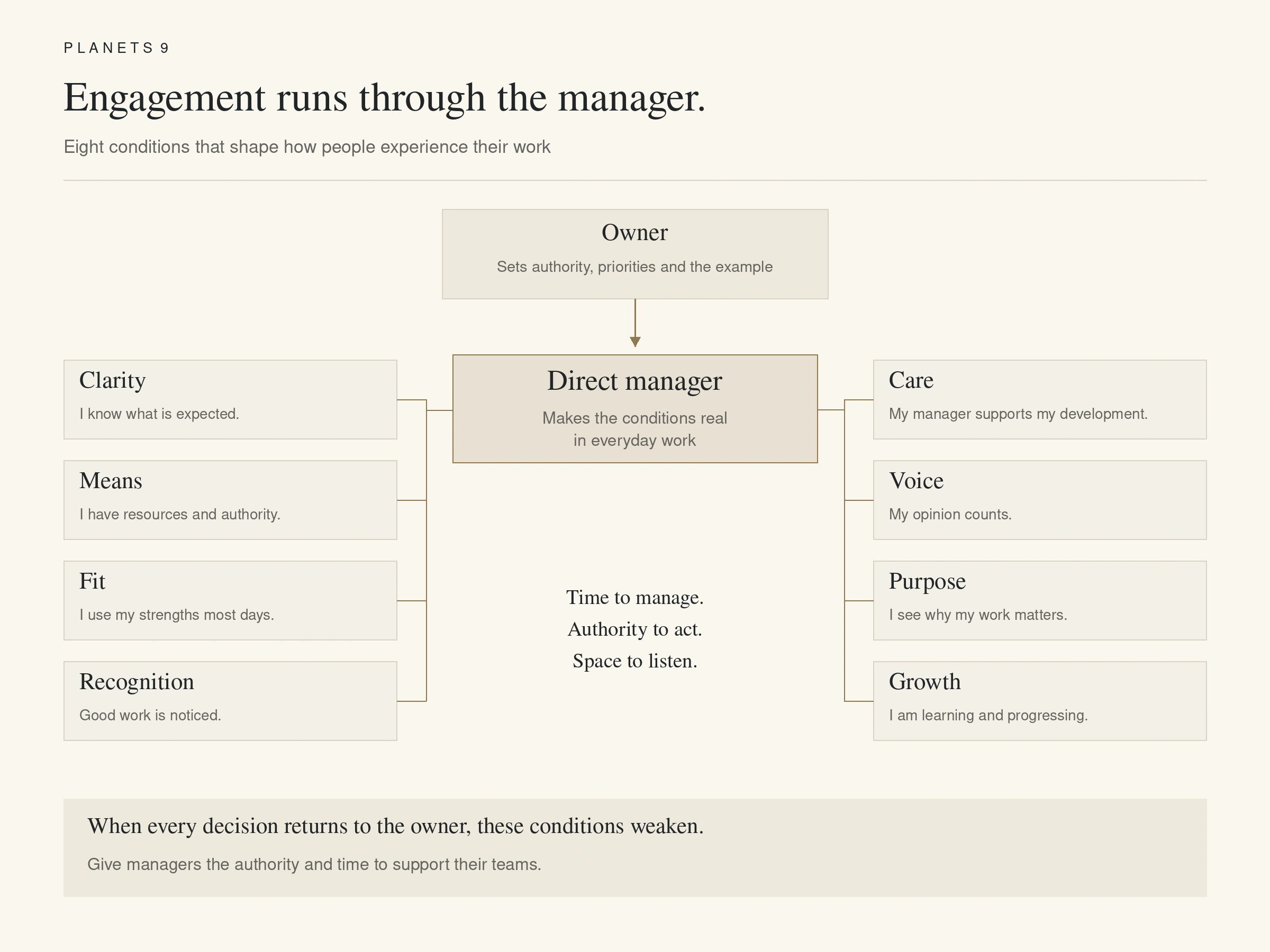
Gallup's Q12, the most-used instrument, measures twelve conditions. Stripped to what matters in a company of sixty, they are these.
Clarity. I know what is expected of me. The single most common gap, and the one that written objectives close.
Means. I have the materials, information and authority to do my work. The empowerment spoke is about the authority half.
Fit. I get to do what I do best most days. The person is in a seat that suits how they operate.
Recognition. Someone has noticed good work in the last week, and said so.
Care. My manager knows me as a person and cares about my development.
Voice. My opinion counts. Disagreement is heard, not punished.
Purpose. The company's work matters, and I can see how mine connects to it.
Growth. I have learned something and progressed in the last year.
Every one of these runs through the direct manager. Gallup's finding across decades of data is that the manager accounts for most of the variance in engagement between teams, which is why engagement in an SME is a question about the department heads and, above them, the owner.
Why engagement is low in owner-run companies
Not because Indian employees are less committed. Because the conditions above are structurally absent.
Expectations are the owner's mood. No written objectives, so clarity is impossible. The functions of management spoke explains why the plan never gets written.
Authority sits at the top. People are responsible for outcomes they cannot control, and learn to stop caring about outcomes they cannot control.
Recognition is scarce and misdirected. The owner notices presence, not results, and rewards the person who told him first over the person who fixed it.
The manager has no time to manage. Department heads are doing the owner's escalations and their own work; the weekly conversation that drives engagement does not happen.
Voice is unsafe. Disagreeing with the owner in a meeting has been seen to cost someone, once, and the lesson generalised.
The ceiling is visible. Growth stops one level below the owner, or one level below the family. The why managers leave essay calls it the ceiling test.
Engagement initiatives that ignore these, the offsite, the fun Friday, the birthday cake, produce a week of goodwill and no change, because the conditions people return to on Monday are the same.
What actually raises engagement
Write the expectations. Three objectives per person, agreed, reviewed monthly. Clarity is the cheapest driver and the most often missing.
Move authority down, in writing. The authority matrix. People engage with what they control.
Give the managers time to manage. Which means taking the escalations off them, which means the owner refusing to be the hub; the span of control spoke is about the arithmetic.
Make recognition specific and weekly. Not an award. A named good decision, mentioned by the manager, in the week it happened.
Make one forum safe. A weekly heads' meeting where disagreement is expected and the owner does not decide first.
Measure it, honestly. A short anonymous survey, twice a year, with the results shared and one thing changed each time. A survey whose results are hidden lowers engagement further.
Show the path. Every person knows what the next role is and what it takes. Where the path is blocked by family, say so, and do not pretend otherwise.
Engagement and the person
The conditions above raise engagement across a company. They do not raise it equally, because people are engaged by different things. Some are engaged by autonomy and disengaged by supervision; some the reverse. Some need to see the purpose; some need to see the number. Some are engaged by a manager who is close and some by one who leaves them alone. A single engagement programme applied to sixty different operating natures produces sixty different results, and the survey averages them into a number that hides the pattern.
That is the layer under the survey. The Business Pulse reads how your organisation actually runs, where decisions form and where they stall, and is the instrument for seeing which conditions are missing for which people.
Questions people ask about employee engagement
What is employee engagement?
The degree to which people are emotionally committed to their work and company, and therefore willing to give discretionary effort beyond what the job requires. It is distinct from satisfaction, loyalty and hours worked.
What are the drivers of employee engagement?
Clear expectations, the means and authority to do the work, a role that fits, regular recognition, a manager who cares, a voice that counts, a sense of purpose, and growth. Most run through the direct manager.
How is employee engagement measured?
Usually by a short anonymous survey on the drivers above, such as Gallup's Q12, run at regular intervals with results shared and acted on. Attrition, absenteeism and exit-interview themes are lagging indicators.
What is the difference between employee engagement and job satisfaction?
Satisfaction is how content a person is with their job and conditions. Engagement is how committed they are to the work and its outcomes. A person can be satisfied and giving the minimum.
What are employee engagement activities?
Offsites, celebrations and team events are the usual answer and produce short-lived goodwill. The activities that change engagement are structural: written objectives, delegated authority, weekly recognition, safe disagreement and visible growth paths.
Why is employee engagement low in India?
Gallup's 2025 report put India's engaged share around 23%. In owner-run companies the structural causes are unwritten expectations, centralised authority, managers without time to manage, unsafe disagreement and a visible ceiling.
Where to go deeper
Organisational Development — the whole discipline.
Employee Empowerment — the means, where this page is about the will.
Organisational Culture — the third level that engagement measures.
Why Your Managers Leave — the ceiling test.
The Quiet Resignation — disengagement from the inside.