SOP Examples: 8 Complete SOPs for Sales, Purchase, Accounts, Dispatch and HR

Most SOP examples online are for hospitals, laboratories or American restaurant chains. The owner of a twenty-person trading, manufacturing or services company in India reads them and still does not know what his own first SOP should look like.
Below are eight complete SOP examples for the departments a small or mid-sized Indian company actually has: sales, purchase, accounts, dispatch, customer service, HR, operations and management. Each shows the standard sections, uses one of the four body formats, and is short enough to issue as written. Change the thresholds, forms and roles to yours and they are usable.
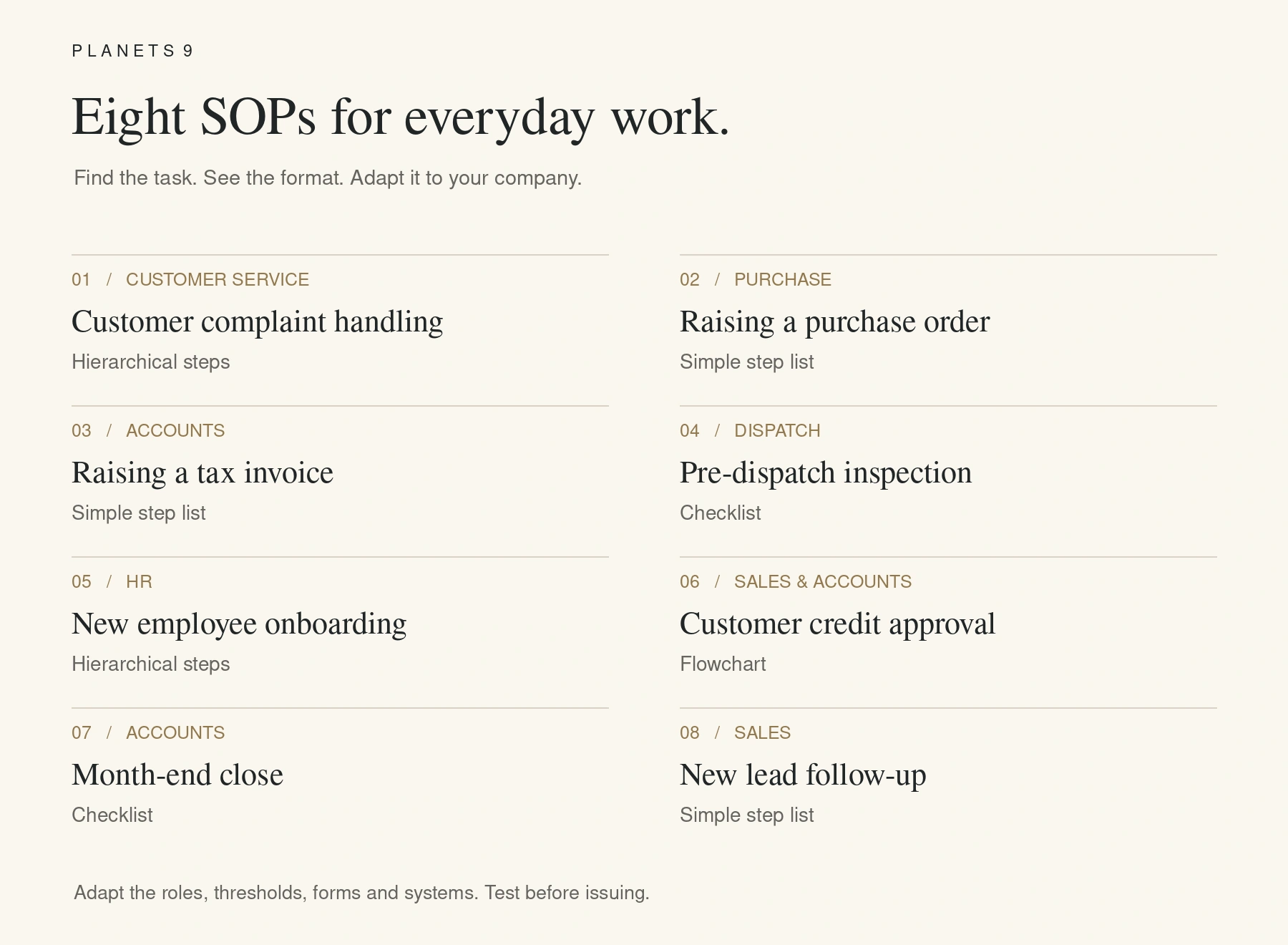
Every example follows the nine-section SOP format. To keep this page readable, the title block, references and revision history are shown once and implied for the rest.
Example 1 — Handling a customer complaint (customer service, hierarchical steps)
Document: SER-SOP-001 v1.0. Purpose: to ensure every customer complaint is acknowledged within one working day, resolved within five, and recorded. Scope: all complaints received by phone, email or WhatsApp; excludes warranty claims (SER-SOP-003). Roles: Sales Coordinator performs; Sales Manager approves remedies ₹10,000–₹50,000; Owner is informed above ₹50,000.
Step 1 — Sales Coordinator logs the complaint in the Complaint Register (Form SER-01) within one hour: date, customer, channel, product, one-line description.
Step 2 — Sales Coordinator sends the standard acknowledgement (Appendix A) on the same channel the complaint arrived.
Step 3 — Sales Coordinator assigns a category: quality, delivery, billing or service, and an owner for resolution.
Step 4 — Resolution owner contacts the customer within one working day to confirm the facts.
Step 5 — If invoice value is under ₹10,000 and the category is quality or delivery, Sales Coordinator offers replacement or credit note directly and records it.
Step 6 — If ₹10,000 to ₹50,000, Sales Manager approves the remedy within one working day and records approval in the register.
Step 7 — If above ₹50,000, or the complaint mentions legal action or a regulator, Sales Coordinator informs the Owner the same day by email with the register entry attached.
Step 8 — Resolution owner confirms the remedy to the customer in writing and records the closure date.
Step 9 — Sales Manager reviews open complaints every Monday; anything open past five working days is escalated.
Records: Complaint Register SER-01, retained three years; monthly complaint summary to management.
Example 2 — Raising a purchase order (purchase, simple step list)
Purpose: to ensure every purchase above ₹5,000 is authorised, compared and recorded before commitment. Roles: Purchase Executive performs; Purchase Manager approves up to ₹2 lakh; Owner above.
Step 1 — Requesting department raises a Purchase Requisition (Form PUR-01) with item, quantity, required date and budget head.
Step 2 — Purchase Executive checks stock on hand in the ERP before sourcing.
Step 3 — For any item above ₹50,000, Purchase Executive obtains two written quotes; above ₹2 lakh, three.
Step 4 — Purchase Executive prepares the PO in the ERP with agreed price, delivery date, payment terms and GST details.
Step 5 — Purchase Manager approves in the ERP; Owner approves above ₹2 lakh.
Step 6 — Purchase Executive sends the approved PO to the vendor and files quotes against the PO number.
Step 7 — Stores confirms receipt against the PO; Accounts pays only against a PO-matched invoice.
Records: PUR-01 requisitions, quotes and POs in the ERP; retained for the current and previous financial year plus statutory period.
Example 3 — Raising a tax invoice (accounts, simple step list)
Purpose: to ensure every invoice is correct in GST terms and issued within one working day of dispatch. Roles: Accounts Executive performs; Accounts Manager checks weekly.
Step 1 — Accounts Executive raises the invoice in the accounting system from the approved sales order and delivery challan; never from a WhatsApp message.
Step 2 — Accounts Executive verifies customer GSTIN against the GST portal on first invoice and whenever the customer's details change.
Step 3 — Accounts Executive confirms HSN code, tax rate, place of supply and payment terms match the sales order.
Step 4 — For invoices above the applicable e-invoicing threshold, Accounts Executive generates the IRN and QR code before release.
Step 5 — Accounts Executive emails the invoice to the customer's registered billing address and records the date sent.
Step 6 — Accounts Manager samples ten invoices weekly against sales orders and notes exceptions in the review log.
Records: invoice register in the system; weekly review log.
Example 4 — Pre-dispatch inspection of finished goods (dispatch, checklist)
Purpose: to ensure no consignment leaves without the product, documents and packaging being confirmed. Roles: Dispatch Supervisor performs and signs; Warehouse Manager countersigns for consignments above ₹1 lakh.
Quantity matches sales order and packing list.
Product code and batch or lot number on every carton match the order.
Visual inspection of outer packaging: no damage, no moisture, seals intact.
Delivery challan prepared and matches the packing list.
Tax invoice attached; e-way bill generated where the consignment value requires it.
Transporter name, vehicle number and driver contact recorded on the dispatch register.
Photographs of the loaded vehicle taken and saved to the order folder.
Customer informed by the agreed channel with expected delivery date.
Signed by Dispatch Supervisor, with time and date; countersigned where required. Records: signed checklist filed with the order; dispatch register.
Example 5 — Onboarding a new employee, first five days (HR, hierarchical steps)
Purpose: to ensure every new joiner has the documents, access, equipment and introductions needed to be productive within a week. Roles: HR Executive coordinates; Reporting Manager owns days two to five.
Day 0 — HR Executive collects signed offer, ID and address proof, bank details and PF and ESI declarations where applicable; issues the appointment letter.
Day 1 — HR Executive completes the induction: company overview, leave and attendance rules, code of conduct acknowledgement, POSH policy briefing; IT provides email, system logins and equipment against a signed asset form.
Day 1 — Reporting Manager introduces the joiner to the team and walks through the role's first-month goals in writing.
Days 2–5 — Reporting Manager assigns a buddy, schedules SOP training for the tasks the role performs, and records each training in the training register.
Day 5 — Reporting Manager and joiner hold a fifteen-minute check-in; HR Executive files the completed onboarding checklist.
Records: personnel file, asset form, training register, onboarding checklist. The reason a new hire's first month goes wrong is rarely the paperwork; the onboarding intelligence gap essay covers the part this checklist cannot.
Example 6 — Approving customer credit (sales and accounts, flowchart described)
Purpose: to ensure credit is extended only within defined limits and on documented information. The flowchart has four decision diamonds:
New customer or existing? New customers receive credit only after Step 2; existing customers proceed on their current limit.
Documents complete? GST certificate, PAN, two trade references and a signed credit application. If not, credit is refused until complete.
Requested limit within Sales Manager authority (₹5 lakh)? If yes, Sales Manager approves in writing. If no, Owner approves.
Any overdue beyond 60 days on the account? If yes, further credit is held automatically and the Sales Manager is notified; no override without the Owner in writing.
Records: credit application file; credit limit master in the ERP; monthly ageing report.
Example 7 — Month-end close (accounts, checklist)
Purpose: to close the books within seven working days of month end with all reconciliations done.
All sales invoices for the month raised and matched to challans.
All purchase invoices received and booked against POs; outstanding GRNs listed.
Bank reconciliation completed for every account.
GST output and input reconciled with the returns filed.
TDS deducted, deposited and recorded.
Payroll booked; PF and ESI challans filed where applicable.
Debtors ageing reviewed; anything over 60 days flagged to Sales Manager.
Inventory valuation confirmed with Stores.
Provisional P&L and balance sheet circulated to management by working day seven.
Signed by Accounts Manager; reviewed by Owner or CFO. Records: signed checklist and reconciliation files per month.
Example 8 — Following up a new sales lead (sales, simple step list)
Purpose: to ensure every inbound lead receives a first response within two working hours and a defined follow-up sequence.
Step 1 — Lead is logged in the CRM within thirty minutes of receipt with source, contact and requirement.
Step 2 — Sales Executive makes first contact within two working hours by phone; if unanswered, by WhatsApp with the standard first message.
Step 3 — Sales Executive qualifies on budget, timeline and decision-maker and records the outcome.
Step 4 — Qualified leads receive a written quote within one working day; unqualified leads are marked with the reason.
Step 5 — Follow-up on day two, day five and day ten after the quote; each attempt recorded.
Step 6 — After three unanswered follow-ups, the lead is marked dormant and moves to the monthly nurture list.
Step 7 — Sales Manager reviews the pipeline every Friday; leads with no activity for seven days are reassigned.
Records: CRM activity log; weekly pipeline review notes.
What the eight have in common
Each names an outcome that can be checked. Each names roles rather than people. Each states the rule at every decision point, with a rupee threshold where money is involved, so the owner is in the loop by design and not by default. Each names a record. None is longer than two pages.
The thresholds are the part to think hardest about. Set them where the company is today, not where it was when the owner approved everything, and the decision bottleneck essay is the place to start if every threshold currently reads "ask the owner".
Questions people ask about SOP examples
What is an example of an SOP in business?
A written procedure for handling a customer complaint: log within an hour, acknowledge the same day, assign a category and owner, resolve within five working days within defined authority limits, record the closure. Example 1 above is the complete version.
What is a simple SOP example?
Raising a purchase order: requisition, stock check, quotes above a threshold, PO in the system, approval by authority level, PO sent and filed. Seven steps, one page. Example 2 above.
What are the most common SOPs in a small company?
Complaint handling, purchase orders, invoicing, dispatch inspection, employee onboarding, credit approval, month-end close and lead follow-up. The department-by-department list gives the first ten to write and the order.
Can I copy these SOP examples?
Yes. Change the roles, forms, thresholds and systems to yours, and test the result on someone who has not done the task before issuing it. The SOP template has the full nine-section layout.
Where to go deeper
SOP Template — the blank layout with wording.
SOP Format — the nine sections explained.
How to Write an SOP — the seven steps, from observation to issue.
SOPs for a Small Business, Department by Department — which to write first.
What Is an SOP? — the full guide.