Organisational Structure: Types, How to Choose One as You Grow, and Why the Chart Never Matches Reality

There are two organisational structures in most companies between twenty and two hundred people. The one on the chart, drawn for the bank or the ISO auditor. And the one everyone actually works in, where every line leads to the owner.
An organisational structure is the arrangement of roles, reporting lines, authority and communication in a company: how work is grouped, who reports to whom, how many people each manager has, and where decisions are made. The main types are functional, divisional, matrix, flat and hierarchical, and most growing companies move from flat to functional to divisional as they add people, products and locations. The type matters less than whether the structure on paper is the structure in practice.
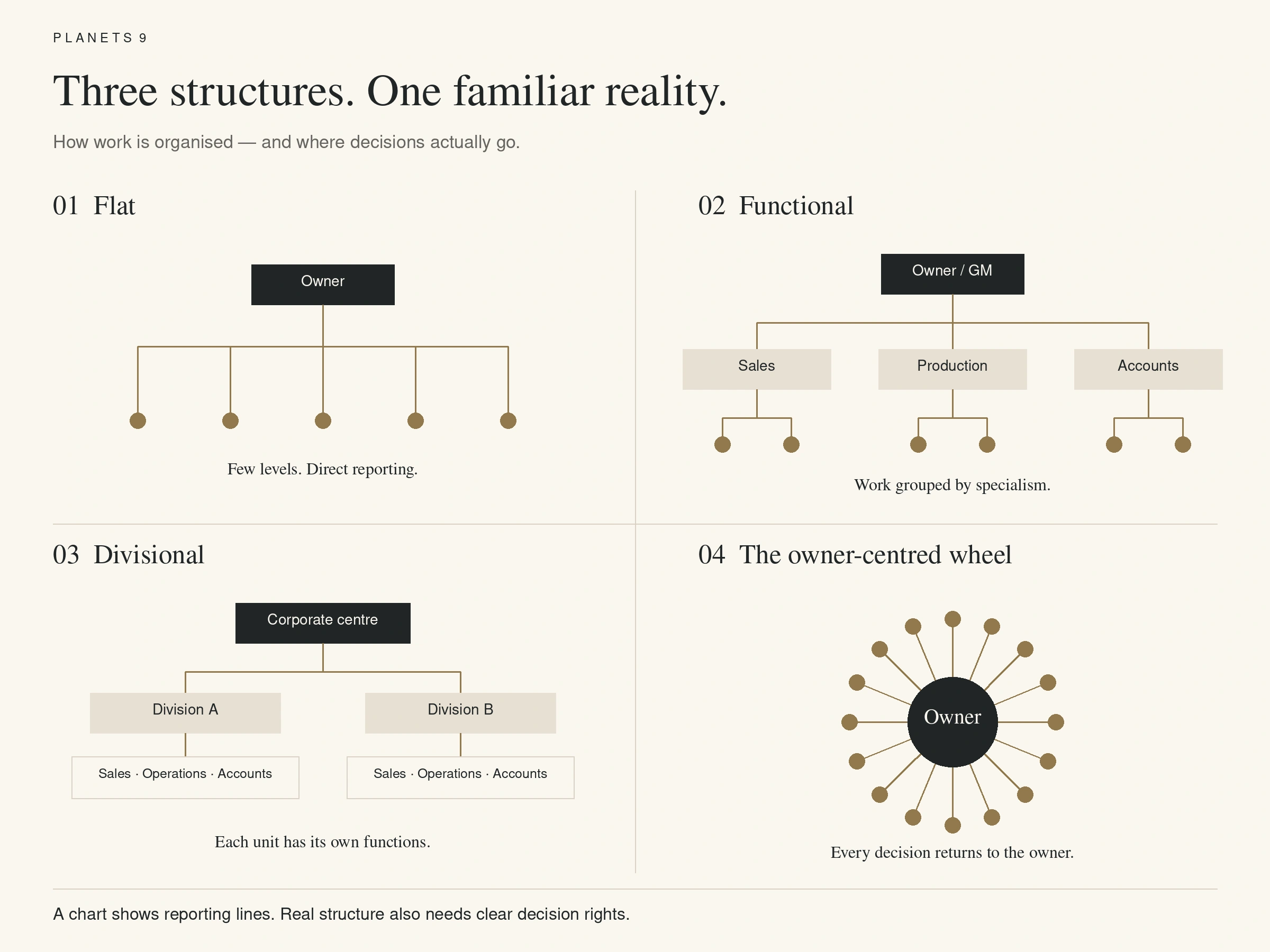
This page gives the types, the four dimensions that define any structure, how to choose at each stage of growth, and why the real structure of an owner-run company is usually a wheel.
The four dimensions of any structure
Every structure, whatever its name, is a set of answers to four questions.
Grouping. How is work divided into units: by function (sales, production, accounts), by product, by region, by customer type, or some combination.
Reporting. Who reports to whom. The chain of authority from the top to the floor, the scalar chain in Fayol's terms.
Span. How many people report to each manager, which sets how many levels the company has. The span of control spoke covers the numbers.
Decision rights. Where each kind of decision is made and up to what limit. The centralisation spoke covers the degree; the authority matrix is the instrument.
Two companies can have identical charts and completely different structures, because the chart shows grouping and reporting and says nothing about span in practice or decision rights.
The types of organisational structure
Flat
Few or no levels between the owner and the people doing the work. Everyone reports to one or two people. Fast, informal, and correct for a company of up to about fifteen. Past that, "flat" stops being a design and becomes the absence of one.
Functional
Work grouped by specialism: a sales department, a production department, an accounts department, each with a head who reports to the owner or general manager. The most common structure for companies of twenty to two hundred, and the right one for a single-product, single-location business. Its weakness is silos: each function optimises itself, and nobody owns the hand-offs between them.
Divisional
Self-contained units by product, region or customer, each with its own sales, operations and often accounts, reporting to a corporate centre. Right for a company with two genuinely different businesses, or locations far enough apart that a functional structure cannot coordinate them. Expensive, because functions are duplicated, and premature for most SMEs that adopt it because the second product felt important.
Matrix
People report to two managers, a functional head and a project or product head. Common in engineering, consulting and large corporates; rare and usually wrong in SMEs, because it deliberately violates unity of command and works only with rules about which boss decides what that small companies do not have.
Hierarchical or tall
Many levels, narrow spans, close supervision. The traditional large-company shape. In an SME it appears when titles are handed out faster than authority, producing four layers of managers who all escalate to the owner.
Line and staff
A line structure (the chain that produces and sells) plus staff roles that advise it (HR, finance, quality). The distinction is useful for one question: staff roles advise, they do not command the line, and a company where the accounts head is giving instructions to sales executives has a line-and-staff confusion.
Choosing a structure at each stage
Structure follows strategy and size, in that order.
Up to fifteen people: flat. The owner manages everyone directly. Writing an org chart is unnecessary; writing the first SOPs is not.
Fifteen to fifty: functional, with three to five department heads who hold real authority. This is the transition most owner-run companies never complete: they add the heads and keep the authority, so the structure is functional on paper and flat in practice. The levels of management spoke is about the missing middle.
Fifty to two hundred: functional with a general manager or COO between the owner and the heads, or divisional if there are two distinct businesses or distant locations. The owner's direct reports drop to a handful. This is where a founder either becomes a chairman or becomes the bottleneck.
Beyond two hundred: divisional, with professional management and the owner on the board. Outside the scope of this page, and the point at which most Indian family businesses either professionalise or plateau.
The real structure: the wheel
Draw the structure from the employee's side rather than the owner's. For each person, ask who they actually take instructions from, who they escalate to, and who can overrule their manager. In most owner-run companies the honest drawing is a wheel: the owner at the hub, every person a spoke, and the department heads sitting on the rim with titles.
The wheel is not a failure of the owner's character. It is the structure that was correct at eight people, kept past the size where it works, because the person who would have to change it is the hub. The owner dependency guide covers the full pattern; the scalar chain spoke covers building a chain where there is a hub.
Restructuring, for this company, means three things and the chart is the least of them. Deciding which decisions move down and to whom, in writing. The owner routing every instruction through the head instead of around him. And choosing heads who can hold authority, which is a people question and not a structural one.

The family in the structure
Family businesses have a second structure that never appears on the chart: family position. The son is in operations, the son-in-law in accounts, the nephew in sales, and each carries authority that comes from the family rather than the role. Managers know it, and route accordingly.
OD in a family business means putting the family on the chart honestly: which family member holds which role, with what authority, reporting to whom, and how disagreements between family members are resolved before they reach a manager. The family business governance essay covers the mechanisms; the unity of command spoke covers the specific violation.
The seat and the person
A structure names seats. It does not say who can sit in them. The functional structure with five department heads works when the five are people who hold authority without checking, coordinate sideways without escalating and carry the standard when the owner is away. The same chart with five people who were promoted for loyalty or tenure produces the wheel again within a quarter.
That is the layer under the design. The Business Pulse reads how your organisation actually runs, where decisions form and where they stall, and is the instrument for seeing which seats are actually being held.
Questions people ask about organisational structure
What is organisational structure?
The arrangement of roles, reporting lines, authority and communication in a company: how work is grouped, who reports to whom, how many people each manager has, and where decisions are made.
What are the types of organisational structure?
Flat, functional, divisional, matrix, hierarchical (tall) and line-and-staff are the main types. Most growing companies move from flat to functional to divisional as they add people, products and locations.
Which organisational structure is best for a small business?
Flat up to about fifteen people; functional, with three to five department heads holding real authority, from fifteen to fifty; functional with a general manager, or divisional if there are distinct businesses, beyond that.
What is the difference between functional and divisional structure?
Functional groups people by specialism (sales, production, accounts) under one management. Divisional groups them into self-contained units by product, region or customer, each with its own functions, under a corporate centre.
What is a matrix structure?
One where people report to two managers, usually a functional head and a project or product head. It suits large project-based organisations and is usually wrong for SMEs because it breaks unity of command.
Why does the org chart not match reality?
Because the chart shows grouping and reporting lines and says nothing about decision rights or span in practice. In owner-run companies the chart is functional and the reality is a wheel with the owner at the hub.
Where to go deeper
Organisational Development — the whole discipline, for a growing private company.
Levels of Management — the missing middle.
Span of Control — the numbers behind the levels.
Scalar Chain — from a hub to a chain.
Family Business Governance in India — the family on the chart.