Professionalising a Family Business: What It Means, What It Does Not, and Why the Hired CEO Usually Fails

The owner hired a chief executive from a multinational. Eighteen months later the chief executive left, the owner was back at his old desk, and the family had a story about how professionals do not understand the business. The professional had a different story, and it was about who actually made the decisions.
Professionalising a family business means changing how the company is run so that it depends on systems, defined roles and capable people rather than on the personal presence and judgement of the family: written authority, a management layer with real power, performance and talent systems that apply to everyone, governance that separates ownership from management, and, where needed, non-family professionals in senior roles. It does not mean removing the family, hiring an outside chief executive, or adopting the vocabulary of a corporation. Most attempts fail because they do the last three and not the first five. The word is used loosely and the failure rate is high, and the two facts are connected.
This page gives what professionalising is and is not, the signs a company needs it, the sequence that works, the reasons the hired chief executive usually fails, and the family's own part in it.
What it is not
It is not hiring an MBA. A professional in an unprofessional structure becomes either a bottleneck's assistant or a departure.
It is not a rebrand, a new office, or a management retreat with a consultant's slides.
It is not the family stepping back. Families that step back from a company with no systems produce a company with no owner and no systems, which is worse.
It is not corporate vocabulary. A company with a chief people officer and no written authority has changed a title.
What it is
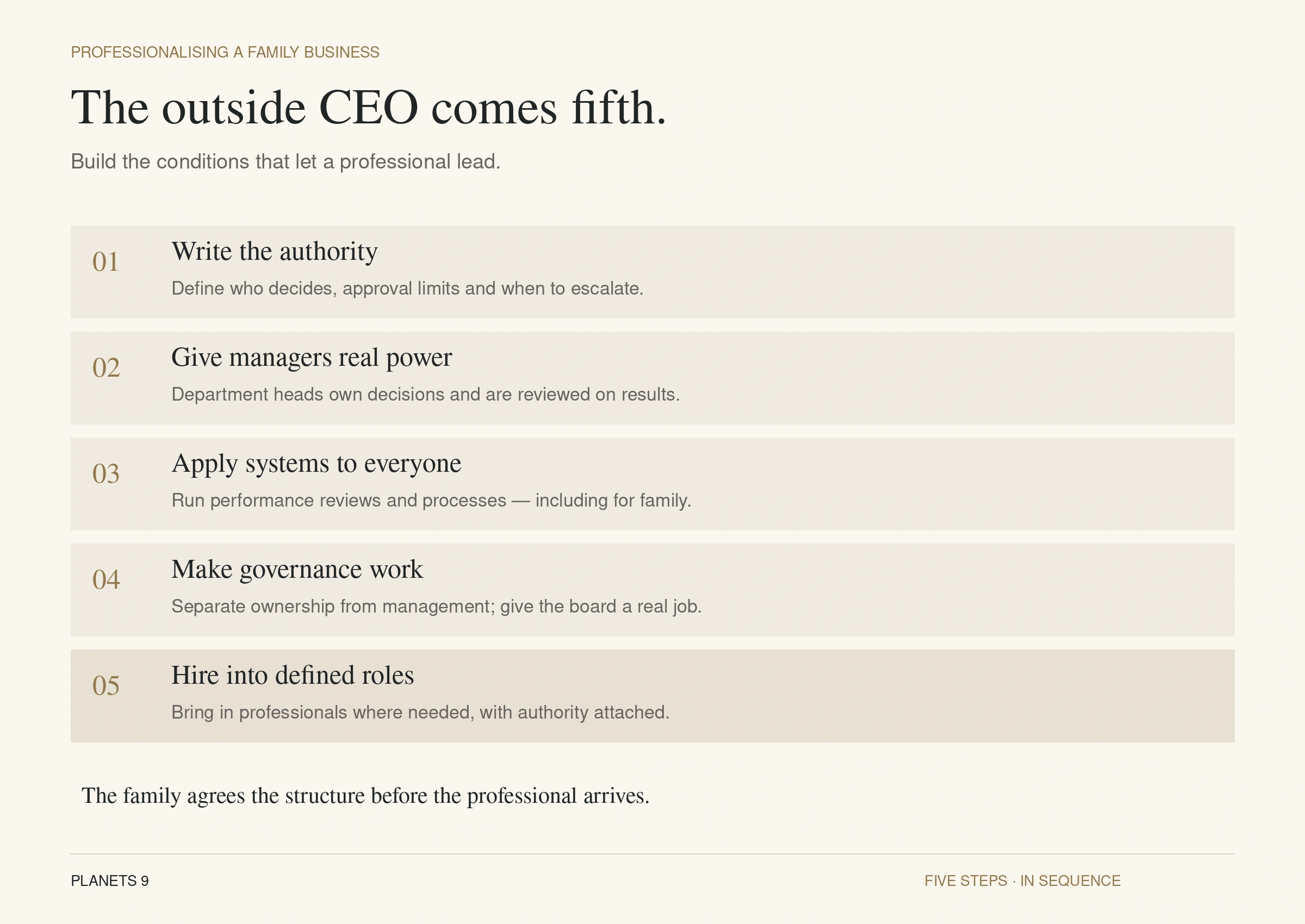
Five things, roughly in this order.
Authority in writing. Who decides what, up to what value, with what escalation. The authority and responsibility spoke gives the one-page matrix. Nothing else in the list works until this exists, because a professional cannot run what he cannot decide.
A management layer that holds. Department heads, family or not, with real authority over their departments, reporting to one person, reviewed on results. The levels of management spoke covers the layer most owner-run companies have on paper and not in practice.
Systems that apply to everyone. Performance management, talent management, SOPs, management by objectives. Written, run by the managers, applied to the family. The last three words are the test.
Governance that separates ownership from management. A board that meets and decides, a family council for family matters, a constitution that records who owns and who runs and how the two interact. The family business governance essay covers the mechanisms.
Professionals in the roles the family cannot fill. Hired into defined seats, with the authority the matrix gives the seat, reporting to a structure rather than to a person. This is the fifth step and most owners make it the first.
The signs a company needs it
The owner is the only person who can approve anything above a small value, and is approving forty things a day.
Department heads have titles and escalate everything.
The company has grown and the margins have not, because nobody below the owner owns a number.
Good non-family managers have left in the last two years for reasons nobody wrote down.
The second generation is arriving and the company has no seats defined for them to enter.
The bank, a customer or an investor has asked who runs the company if the owner is unavailable, and the answer took too long.
The family has begun to disagree, and there is no forum in which the disagreement can be had.
Why the hired chief executive fails
Not from lack of ability. From arriving at step five of a company that has not done steps one to four.
He has a title and no matrix, so every decision he makes can be reversed by the owner, and the company knows it within a month. He inherits department heads who report to him on paper and to the owner in practice. He is asked to change the culture and is not allowed to change who is exempt from it. He proposes systems and is told the company is not like that. He is compared, in every family conversation, with the founder, who built the company with none of this.
And the family did not agree on what he was for. The owner wanted relief; the son wanted a placeholder; the brother wanted an ally. The professional was hired into three jobs and could hold none.
The chief executive who survives is hired after the matrix is written, the heads have authority, the systems exist and the family has agreed in writing what he decides and what they keep. Which means the professionalising was done by the family before he arrived, and he was hired to run it, not to build it.
The sequence that works
Assess before designing. How the company actually runs: where decisions form, where they stall, who people take instructions from. The organisational development pillar puts this first for a reason.
Write the matrix and hold it for two quarters. The owner refuses decisions below his line, every time, until the refusing is a habit. This is the step that is done alone, and it is the hardest.
Choose the heads on evidence. Family or not. Each holds real authority over a department for a year and is judged on results. The meritocracy spoke covers what merit means in a company where loyalty was the original merit.
Install the minimum systems, and apply them to the family first. The company decides whether the systems are real by watching the first family review.
Give governance a job. Board, council, constitution, in that order of urgency. The board decides the things the owner used to decide alone; the council decides family matters away from the boardroom.
Then hire the professionals, into seats. With the authority the matrix gives the seat, reporting to the structure, protected by the owner from the family and from himself.
Define what the owner keeps, and let the rest go. Chairmanship, key relationships, a short list of reserved decisions. Written. The father who won't let go essay is about the owner for whom this step is the whole difficulty.
The family's part
Professionalising is something the family does to itself before it does anything to the company. It agrees who is in management and who is in ownership only. It agrees that family members in management are reviewed like anyone else. It agrees what the founder keeps. It agrees how disputes are resolved and how a member exits a role. It writes these down.
A family that has not done this cannot professionalise the company, because every system will meet the exemption at the top and stop there. The nepotism pillar covers the exemption; the point here is that professionalising is mostly the removal of it.
The people in the new structure
A professionalised structure is a set of seats with authority attached. It works when the people in the seats, family and hired, are built to hold authority, run teams and take direction from a structure rather than from a patriarch. Some of the existing heads are. Some, loyal and capable in the old structure, are not, and the new structure will reveal it within two quarters. Some of the professionals hired to fill seats will turn out to have been built for a corporation's structure and not for a family's, and the right person, wrong company stage essay describes that mismatch.
That is the layer under the structure. The Business Pulse reads how your organisation actually runs, where decisions form, where they stall, and how much still routes through you, and is the instrument for seeing which seats in the new structure are being held and which are being occupied.
Questions people ask about professionalising a family business
What does professionalising a family business mean?
Changing how the company is run so that it depends on written authority, a management layer with real power, systems that apply to everyone including the family, governance that separates ownership from management, and capable people in defined seats, rather than on the family's personal presence.
Does professionalising mean removing the family from management?
No. It means family members in management hold defined seats, with authority attached, on the same terms as anyone else, and family members who are owners only stay out of operations. Families that simply step back from an unsystematised company make it worse.
Why do outside CEOs fail in family businesses?
Because they are hired before the authority matrix, the management layer, the systems and the family agreement exist. Their decisions can be reversed, their heads report to the owner in practice, they are asked to change a culture they cannot change the exemptions in, and the family did not agree what they were for.
When should a family business professionalise?
When the owner is the only approver and is approving everything, when department heads escalate rather than decide, when good non-family managers are leaving, when the second generation is arriving with no defined seats, or when the family has begun to disagree with no forum to do it in. Usually between twenty and a hundred employees.
What is the first step in professionalising a family business?
Assessing how the company actually runs, then writing the authority matrix and holding it for two quarters. Hiring a professional is the fifth step, not the first.
What is the role of the founder after professionalising?
Defined and written: usually chairmanship, the key external relationships, and a short list of reserved decisions. The founder who keeps an undefined role keeps everything, and the professionalising reverses within a year.
Where to go deeper
Nepotism: Meaning, Examples, and the Family-Business Version — the pillar.
Family Business Governance in India — board, council and constitution.
Authority and Responsibility — the matrix that comes first.
Organisational Development — the discipline this is one application of.
The Father Who Won't Let Go — the founder's step.