What Is an SOP? Standard Operating Procedure Meaning, Format and How to Write One

Somewhere in your company there is a job that only goes right when a particular person does it. Everyone knows who. Nobody has written down what they do.
That is the gap an SOP closes.
SOP stands for Standard Operating Procedure: a written, step-by-step description of how a specific task is done in your company, by whom, to what standard, so that the result is the same whoever does it. In a business context that is the only meaning that matters. Students searching the same three letters usually want the other SOP, a Statement of Purpose for a university application, and that page is here. This one is for the owner or manager who wants the work to come out right without standing over it.
This page covers what an SOP is and is not, the formats that exist, how to write one that people actually follow, where most Indian SMEs go wrong, and the point at which SOPs stop being the answer.
What is an SOP?
An SOP is the company's memory for a task, written so that a competent person who has never done it can do it acceptably the first time.
Three words in the definition carry the weight. Standard means the outcome is fixed: a customer complaint is acknowledged within four hours, a purchase order above ₹50,000 gets two quotes, a dispatch leaves with a signed challan. Operating means it describes how the work runs day to day, not what the company believes. Procedure means it is a sequence of steps with a start and an end, not a policy and not a job description.
An SOP is not a policy. A policy says what the company will and will not do. An SOP says how a specific piece of work is carried out within that policy. An SOP is not a process map, which shows how work flows across departments. And it is not a work instruction, which is the fine-grained detail of one step inside an SOP. The full comparison is worth ten minutes because most companies write one when they need another.
Why do businesses write SOPs?
Owners write their first SOP for one of four reasons, and the reason shapes the document.
Consistency. Two salespeople quote the same product at two prices. Three people close the month three ways. The SOP makes the output the same regardless of who produced it.
Handover. The one person who knows how to do it is leaving, going on maternity leave, or is the owner and would like a Sunday. The SOP moves the knowledge out of a head and into the company.
Compliance. ISO 9001, GMP under Schedule M, FSSAI, a large customer's vendor audit. Someone external will ask to see how the work is controlled, and "ask Ramesh" is not an answer. The ISO 9001 SOP format is its own spoke.
Scale. The company is opening a second branch, a second shift or a second city and the founder cannot be in both. SOPs are how the first location's standard travels.
The first two reasons produce useful SOPs. The third often produces documents written for the auditor that nobody on the floor has read. The fourth is where SOPs earn their keep, and where they most often fail, because a procedure that lived in one person's habits rarely survives its first contact with a team that did not build it.
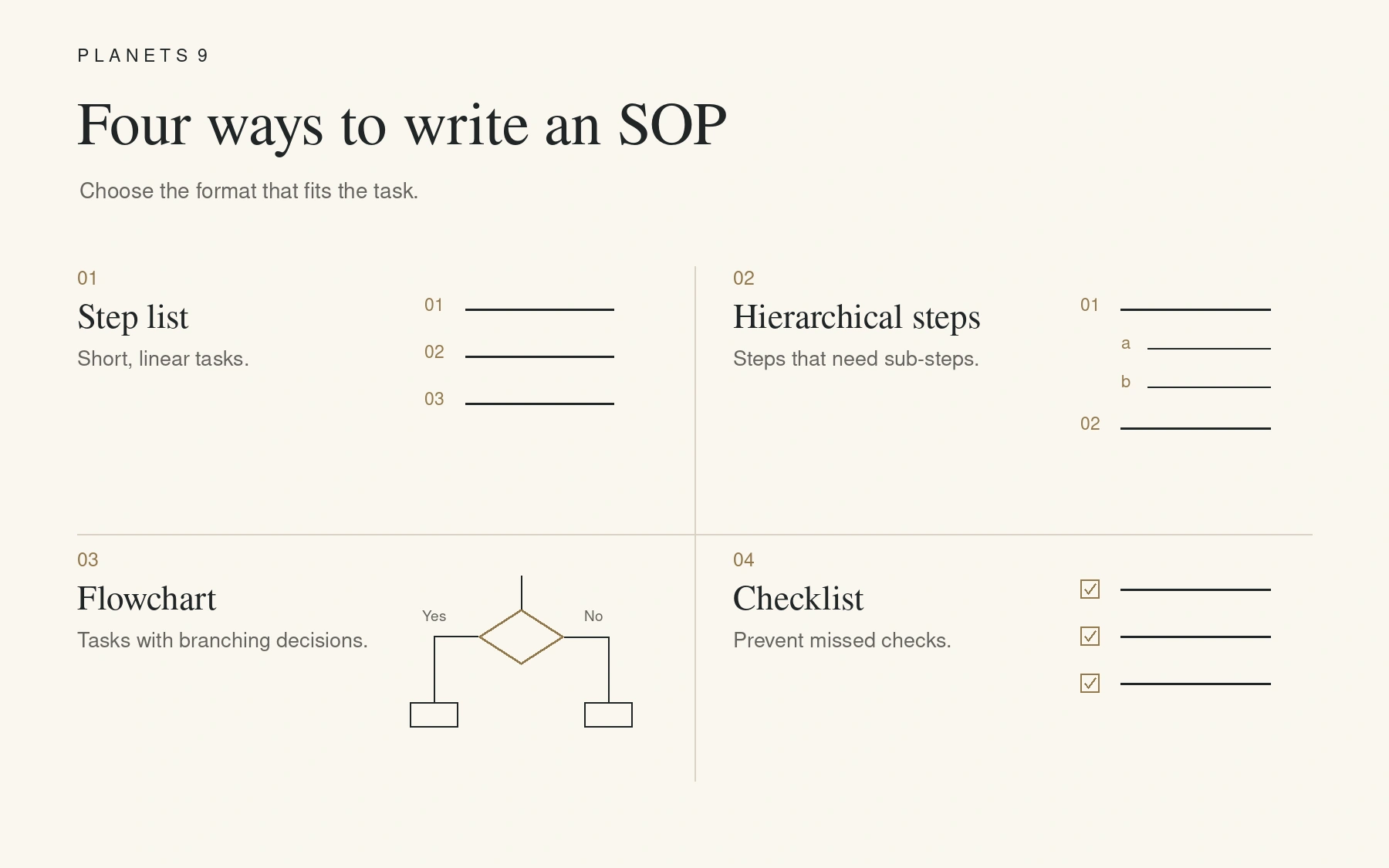
The four SOP formats, and which one to use
There is no single correct SOP format. There are four, and the choice depends on how many decisions the task contains.
Simple step list
A numbered sequence of actions. Best for short, linear tasks with no branching: opening the shop, raising a proforma invoice, closing the till. Rarely longer than one page. Most SOPs in a small company should be this.
Hierarchical steps
Numbered steps, each with lettered sub-steps. Used when a step needs more detail than one line but the overall task is still linear: onboarding a new customer on the accounting system, preparing a tender submission. This is the format most SOP templates default to, and the one auditors expect.
Flowchart
A diagram with decision diamonds. Used when the task branches: a customer complaint that goes one of three ways depending on value, a credit approval that depends on the customer's history. A flowchart shows in one glance what would take two pages of "if… then…" prose.
Checklist
A list of items to confirm, with a tick box, usually signed at the end. Used for tasks where the steps are known and the risk is omission rather than method: pre-dispatch inspection, month-end close, site safety before work starts. The checklist is the format that survives longest on a shop floor because it is used, not read.
The SOP format spoke shows the nine sections every SOP carries regardless of which of the four bodies it uses.
How do you write an SOP?
Seven steps, in this order. Skipping the first two is the reason most SOPs are wrong on the day they are issued.
Pick a task that is failing, not a task that is easy. The first SOP should be the one where errors cost money or the one that only one person can do. Not the one that is simplest to write.
Watch the task done, twice, by two people. Not what the manual says. Not what the manager thinks happens. What actually happens. Where the two people differ is where the SOP has to decide.
Name the outcome first. One sentence: what does "done" look like, and how will anyone know. If you cannot write that sentence, you do not yet have a procedure, you have an activity.
Write the steps in the order they happen, in plain language, one action per step. "Check the stock" is not a step. "Open Tally, go to Stock Summary, confirm quantity on hand is at least the order quantity" is a step. Assume a competent new joiner, not an expert and not a fool.
Add the decision points. Every place where the person has to choose, write down the rule that decides. If there is no rule, that is a decision the owner has been making by phone, and the SOP has just found it.
Test it on someone who did not write it. Hand it to a person who has never done the task and watch them. Every question they ask is a missing line.
Assign an owner and a review date. An SOP with nobody's name on it is nobody's problem. Six months for anything customer-facing; twelve for the rest.
The step-by-step guide expands each of these with a worked example, and the SOP examples page shows eight finished ones from the departments an SME actually has.
AI increases speed. It does not increase clarity.
The reason that line belongs in an article about SOPs is that in 2026 the fastest way to produce a procedure is to ask a language model for one, and the result is a plausible document that describes how a generic company does the task. It has not watched your people. It does not know that your dispatch clerk checks the e-way bill before the challan because of what happened in 2023. The speed is real. The document is not yours until steps two and six have happened.
What does a good SOP contain?
Nine sections, in the header and footer of every SOP whatever the body format. Title and a unique number. Purpose in one sentence. Scope: which team, which situations, which exclusions. Roles: who performs, who checks, who approves. Definitions where a term could be read two ways. The procedure itself. Records: what gets written down or filed as evidence that it was done. References: the policy, standard or form it depends on. Revision history: version, date, what changed, who approved.
The format page shows each of these with the exact wording to use.
Where do SOPs go wrong in Indian SMEs?
The pattern is consistent enough across sectors to be named.
Written for the auditor, filed in a cupboard. ISO or a customer audit demanded documents; a consultant produced forty of them in a fortnight; the certificate is on the wall; nobody on the floor has read one. The SOPs describe an imaginary company.
Written by the owner from memory. The procedure records what the owner did in 2019, not what the team does now. The team knows this and quietly ignores it, which teaches them that SOPs are optional.
Too long. A twelve-page SOP for a task that takes twenty minutes will not be read. If a step needs more than a line, it is a work instruction and belongs in an appendix.
No decision rules. The SOP lists the steps and stops at every point where a judgement is needed with "escalate to management". Management is the owner. The owner's phone keeps ringing. Nothing has changed except the paperwork.
No review. The supplier changed, the software was upgraded, GST rules moved, and the SOP still says what it said in 2022. One outdated SOP teaches the team to distrust all of them.
Sahab knows better. The SOP says two quotes; the owner approves a single-quote purchase on WhatsApp because he knows the vendor. The exception is correct; the lesson the team takes is that the SOP is what you follow when sir is not looking.
The last one matters most and is the least discussed. An SOP is a decision the company has made in advance. Every time the owner overrides it in person, the decision moves back to the owner. Companies that cannot make SOPs stick almost never have a documentation problem. They have an owner dependency problem, and the SOPs are where it shows.
SOPs and the business that runs without you
Owners usually come to SOPs from one of two directions. Some want a certificate. The rest want a business that does not need them at every step.
For the second group, SOPs are necessary and not sufficient. They move the how out of your head. They do not move the who. A procedure that says "the sales manager approves discounts up to 10%" only works if the sales manager is a person who can hold that authority without checking, and the SOP cannot tell you whether he is.
That is the layer below the document. Every procedure in the company will be carried by a particular person, and people carry structure differently. Some run a checklist with relief. Some experience it as a cage and route around it within a month. Some follow it exactly and never notice when it has stopped making sense. The same SOP produces three different companies depending on who inhabits it.
The order that works, in companies that have done this, is: pick the task, watch it, write it, test it, and then look hard at who will own it. Not who is available. Who is built for it. The spoke on why SOPs fail goes into this in detail, because it is the step every SOP guide leaves out.
Questions owners ask about SOPs
What is the full form of SOP?
In business, Standard Operating Procedure. In university admissions, Statement of Purpose. In digital electronics, Sum of Products. The three have nothing in common beyond the letters; the SOP full form page covers each.
What is the difference between an SOP and a process?
A process is the whole flow of work from trigger to outcome, often across several teams, usually drawn as a map. An SOP is the written procedure for one task inside that process. Order-to-cash is a process. Raising a tax invoice is an SOP within it.
How long should an SOP be?
As short as it can be while still letting a competent new person do the task correctly. One to three pages is normal. If it is longer, the task should be split or the detail should move to work instructions.
Who should write the SOP?
The person who does the task, with the person who manages it reviewing. Not the owner from memory and not an outside consultant alone. Ownership of the document should sit with the role that performs it.
Do small businesses need SOPs?
A business with under ten people can often run on habit and proximity. Past that, or past one location, or the moment a key person could leave, the absence of SOPs starts costing more than writing them. The department-by-department spoke lists the first ten to write.
How often should SOPs be reviewed?
Customer-facing and compliance SOPs every six months; the rest annually; any SOP immediately when the system, supplier, law or product it depends on changes. Every SOP carries a review date and an owner's name, or it will not be reviewed.
Can I use ChatGPT to write SOPs?
For a first draft of the structure, yes. For the content, only after someone has watched the task done in your company and corrected every line. A generic procedure that nobody follows is worse than none, because it teaches the team that SOPs are decoration.
See who is actually carrying the procedure
The steps above will give you a set of SOPs that describe how your company really works. What they cannot show is how each person in the business relates to structure: who will run a procedure faithfully, who will improve it, who will route around it, and where authority written on paper is still travelling back to you by phone.
The Business Pulse reads how your organisation actually runs, where decisions form, where they stall, and how much of the work still routes through you. Fifteen minutes, answered as the owner, before you hand the first SOP to the person who will own it.
Where to go deeper
SOP Full Form — the three things SOP stands for, and which one you mean.
SOP Format — the nine sections, with exact wording.
How to Write an SOP — the seven steps with a worked example.
SOP Examples — eight finished SOPs from an SME's departments.
SOP Template — copy it, no email required.
SOP vs Work Instruction vs Policy vs Process — the four documents companies confuse.
Process Documentation — map the process before you write the procedure.
ISO 9001 SOP Format — what the auditor is actually checking.
SOPs for a Small Business, Department by Department — the first ten to write.
Why SOPs Fail — and the people question underneath.
Owner Dependency: Why Your Business Can't Run Without You — the larger pattern SOPs are one part of.