SOP Format: The 9 Sections Every SOP Needs (With the Four Body Layouts)

Most SOPs that fail an audit or get ignored on the floor share a fault that has nothing to do with the steps. The format is wrong. Sections are missing, or the wrong body type was used for the kind of task it describes.
A standard SOP format has nine sections: title and document number, purpose, scope, roles and responsibilities, definitions, the procedure itself, records, references, and revision history. The procedure section takes one of four body formats depending on the task: a simple step list, hierarchical steps, a flowchart, or a checklist. The nine sections are the same whether you are writing for ISO 9001, GMP, a customer audit or your own dispatch desk.
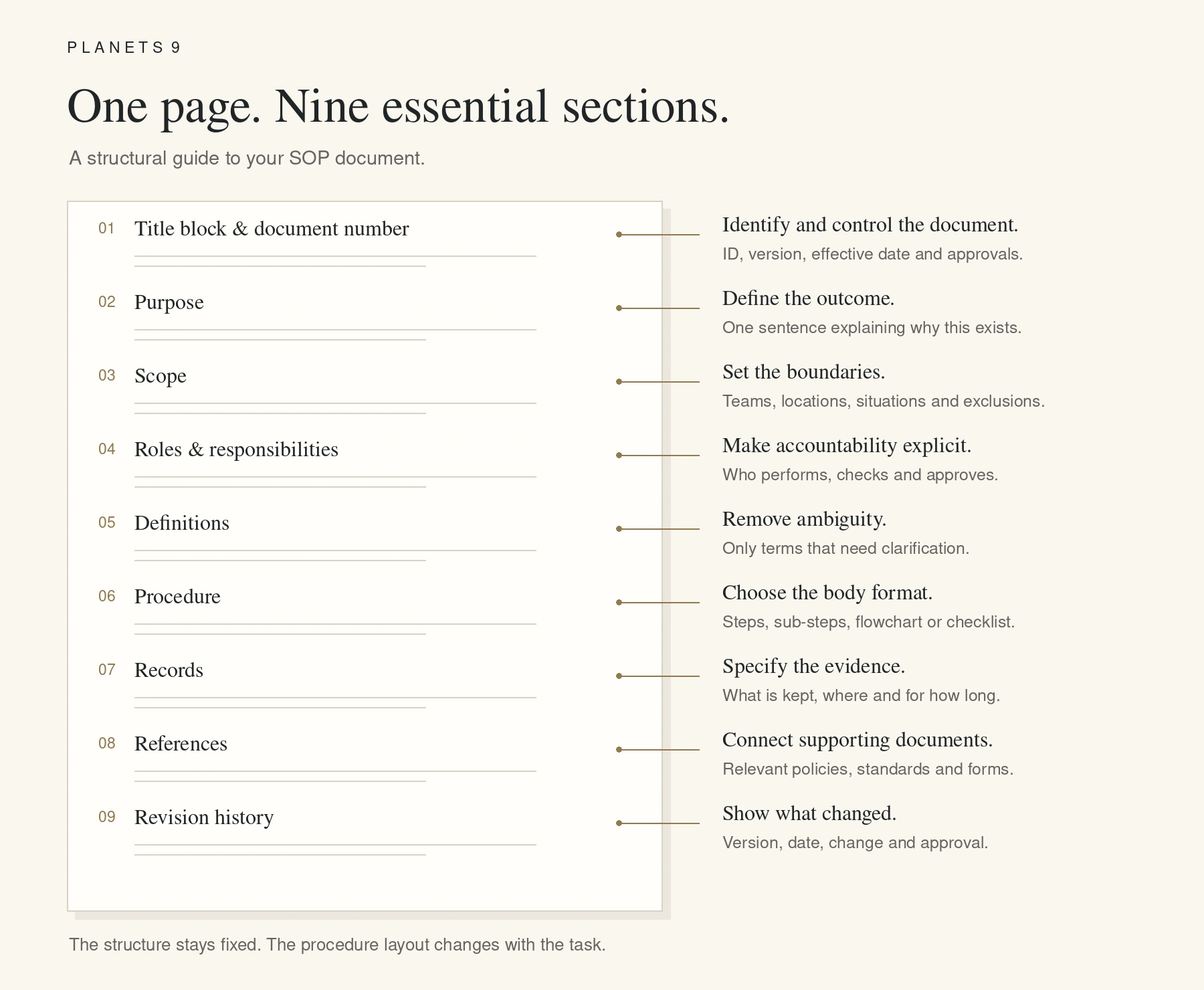
This page gives each section with the exact wording that works, then the rule for choosing the body format. The SOP template page has the whole thing laid out for copying.
The nine sections of an SOP, in order
1. Title block and document number
The title names the task in the form "verb + object": "Raising a Tax Invoice", "Handling a Customer Complaint", "Pre-dispatch Inspection of Finished Goods". Not "Invoice SOP" and not "Sales".
The document number is unique and tells you the department and the sequence: SAL-SOP-004, ACC-SOP-011. Add version, effective date, the name of the person who prepared it, the name who reviewed it and the name who approved it. Three names, not one, because a procedure one person wrote and approved alone has not been checked.
2. Purpose
One sentence, starting with "This procedure describes how…" or "The purpose of this procedure is to ensure that…". If you need two sentences, the second states what goes wrong when the procedure is not followed. Nothing else.
3. Scope
Which team, which situations, which locations. Then the exclusions, which matter more than the inclusions. "Applies to all customer complaints received by phone, email or WhatsApp at the Mumbai and Pune offices. Does not cover warranty claims, which are handled under SER-SOP-003."
4. Roles and responsibilities
Roles, not names. "Sales Executive", not "Priya". For each role: performs, checks, or approves. A procedure with three performers and no checker is a procedure nobody is accountable for.
5. Definitions and abbreviations
Only the terms that could be read two ways. "Working day: Monday to Saturday excluding declared holidays." "Complaint: any expression of dissatisfaction from a customer, whether or not a remedy is requested." If the list runs past six items, the procedure is probably doing too much.
6. Procedure
The body. The rule for its length is that a competent new joiner can complete the task correctly with it and nothing else. One action per step. Each step names who does it. Each decision point states the rule that decides it. This is the section where the four body formats below apply.
7. Records
What evidence exists that the procedure was followed: the form filled, the register entry, the system record, the signed checklist. Name the record, where it is kept, and for how long. Auditors go straight to this section. So should you, because a procedure with no record is a procedure you cannot tell was followed.
8. References
The policy, standard, law, form or other SOP this one depends on. "Credit Policy v3", "ISO 9001:2015 clause 8.2", "Form F-ACC-07 Payment Voucher". Link them if the SOP is digital.
9. Revision history
A small table or list at the foot: version, date, what changed, who approved. Version 1.0 is the first issue; 1.1 is a minor correction; 2.0 is a rewrite. Without this section nobody can tell whether the copy in their hand is current.
The four body formats
The nine sections stay fixed. The body, section six, changes with the task. The rule is the number of decisions the task contains.
Simple step list
Numbered steps, one action each. For linear tasks with no branching and under ten steps: opening the shop, raising a proforma, logging a lead. The default for most SOPs in a company under fifty people.
Hierarchical steps
Numbered steps with lettered sub-steps beneath each. For linear tasks where some steps carry detail: month-end closing, onboarding a customer on the ERP, preparing a tender file. This is the layout most auditors and most templates expect. Keep sub-steps to a line each; if they need more, they are work instructions and belong in an appendix.
Flowchart
Boxes for actions, diamonds for decisions, arrows for flow. For tasks that branch: complaint handling where the path depends on value, credit approval that depends on customer history, a hiring process with a rejection at each stage. One page. If it does not fit on one page the process should be split into two SOPs.
Checklist
Items to confirm, tick boxes, a signature and date at the end. For tasks where the steps are already known and the risk is omission: pre-dispatch inspection, vehicle check before a site visit, month-end close. This is the format that survives longest on a shop floor, because it is used during the task rather than read before it.
Formatting rules that make the difference
Present tense, active voice, imperative mood: "Check the e-way bill", not "the e-way bill should be checked".
One action per step. If a step has "and" in it, it is two steps.
Numbers, not bullets, for the procedure section, so a step can be referred to by number in training and in audits.
No paragraph over three lines inside the procedure. Explanation goes in Purpose or in a note, not in a step.
Header on every page with document number, version and page x of y. Loose SOP pages without a header are the commonest reason a superseded version is still in use.
A4, single column, 11-point type. Print it and read it at the place the task is done. If it is unreadable there, it is unreadable.
SOP format for ISO 9001 and GMP
ISO 9001:2015 does not prescribe a format. It requires that documented information be identified, controlled, available and protected, which in practice means the title block, document number, revision history and approval names above. The ISO 9001 SOP format spoke lists what the auditor will actually look for.
GMP under the revised Schedule M in India, and pharmaceutical practice generally, expects the same nine sections with a stricter reading of records and training: each SOP has a training record showing who was trained on which version. The format does not change; the evidence does.
Questions people ask about SOP format
What is the standard format of an SOP?
Nine sections: title block and number, purpose, scope, roles, definitions, procedure, records, references, revision history. The procedure section is written as a step list, hierarchical steps, a flowchart or a checklist depending on the task.
What is a hierarchical SOP format?
Numbered main steps, each with lettered sub-steps that give detail. It is used when the task is linear but individual steps need more than one line. It is the format most templates default to.
Should an SOP be in Word or PDF?
Draft and maintain in Word or Google Docs so it can be revised; issue as a controlled PDF so the floor copy cannot be edited. The master file location and the PDF issue date go in the revision history.
How many pages should an SOP be?
One to three for most tasks. A ten-page SOP is either three SOPs or an SOP with work instructions that should be appendices.
Does an SOP need a flowchart?
Only if the task branches. A linear task does not need a flowchart and is harder to follow as one. A task with three or more decision points is easier to follow as a flowchart than as prose.
Where to go deeper
SOP Template — the nine sections laid out, ready to copy.
How to Write an SOP — the seven steps from watching the task to issuing the document.
SOP Examples — eight finished SOPs showing all four body formats.
ISO 9001 SOP Format — what changes when an auditor will read it.
What Is an SOP? — the full guide.