SOP vs Work Instruction vs Policy vs Process: The Four Documents Companies Confuse

Ask five managers in the same company for "the process document" and you will get a policy, two SOPs, a flowchart and a checklist. All of them called the process.
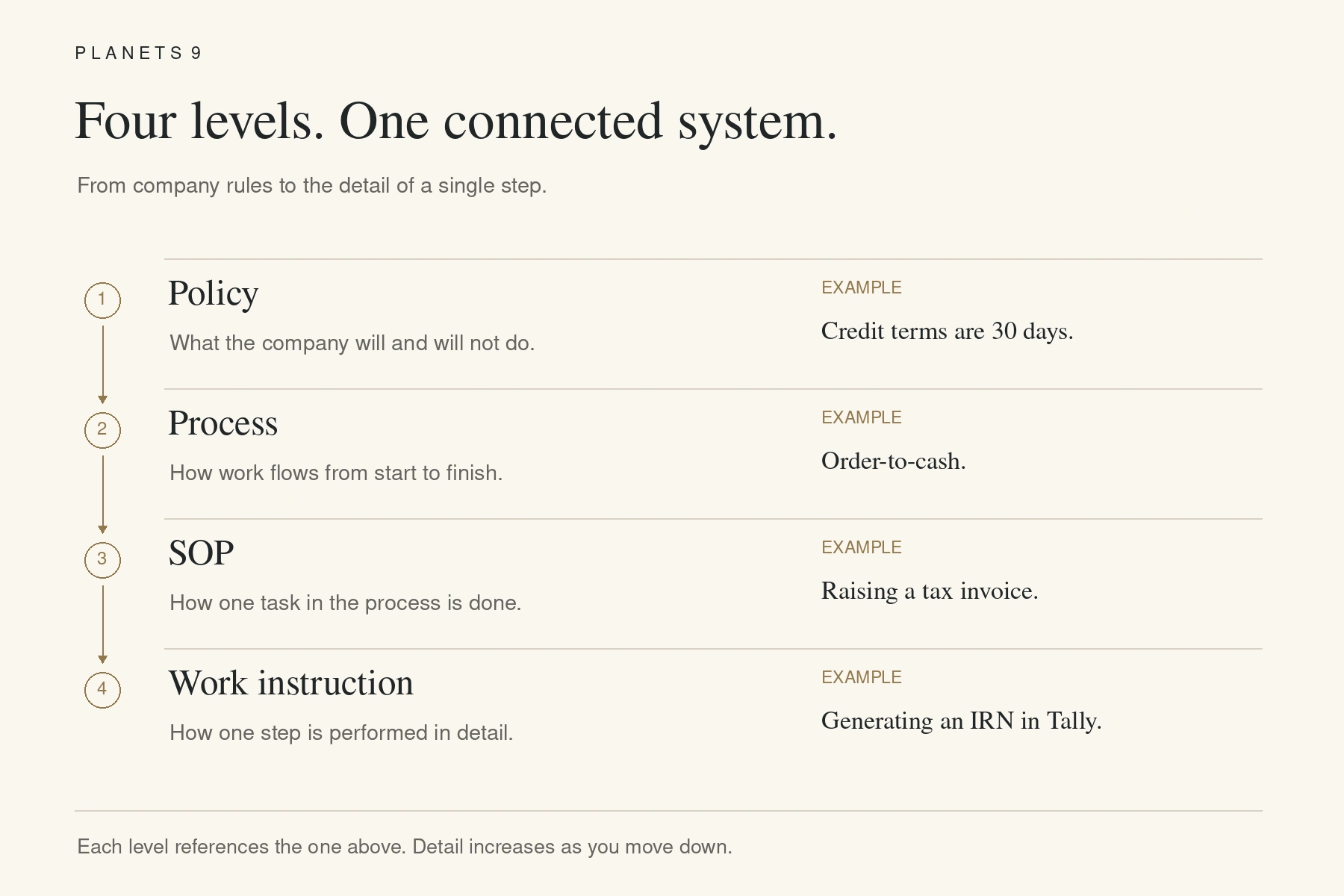
A policy states what the company will and will not do. A process shows how work flows from a trigger to an outcome, usually across several roles or departments. An SOP is the written procedure for one task inside that process, step by step. A work instruction is the fine detail of how one step in an SOP is performed. Four documents, four levels of detail, and most companies write one when they need another.
This page gives the definition, an example and the tell-tale signs of each, then the rule for which one to write.
Policy: what the company will do
A policy is a position. It answers "what is our stance" and it rarely contains a step.
Example: "Credit is extended only to customers who have completed a credit application and provided two trade references. Standard credit terms are 30 days. Credit limits above ₹5 lakh require the approval of the Managing Director."
Tell-tale signs: written in the present tense as rules, approved at board or owner level, changes rarely, applies to everyone. A policy that contains "Step 1" is a procedure wearing the wrong title.
Process: how work flows end to end
A process is the whole chain from trigger to outcome. It usually crosses departments and is best shown as a map or a swim-lane diagram rather than prose.
Example: order-to-cash. Enquiry, quote, order, credit check, production or picking, dispatch, invoice, collection. Eight stages, four departments, a dozen hand-offs.
Tell-tale signs: has a clear start event and end event, involves more than one role, is measured by cycle time or cost, and contains several SOPs inside it. Process documentation is the discipline of mapping this before writing any of the procedures inside it.
SOP: how one task inside the process is done
A Standard Operating Procedure is the step-by-step written procedure for a single task within a process. One performer or a small group, one outcome, one to three pages.
Example: within order-to-cash, "Raising a Tax Invoice" is an SOP. Six steps, one role performing, one checking, one record.
Tell-tale signs: has a document number, a purpose, a scope, roles, numbered steps and a records section. Follows the nine-section format. If it crosses three departments, it is a process, not an SOP, and should be split.
Work instruction: how one step is performed in detail
A work instruction is the fine detail beneath a single SOP step, usually with screenshots, diagrams or machine settings. Where the SOP says "generate the IRN", the work instruction shows the exact screens and fields.
Example: "WI-ACC-004: Generating an e-invoice IRN in Tally", with screenshots of each menu.
Tell-tale signs: specific to one system, machine or workstation; changes whenever the system changes; often visual; referenced from an SOP step rather than read on its own. On a factory floor, the laminated sheet at the machine is a work instruction. The document in the QA file that says when the machine is run and by whom is the SOP.
The hierarchy in one view
Policy — what we do. Owner or board. Changes rarely. "Credit terms are 30 days."
Process — how work flows. Cross-functional. Drawn as a map. "Order-to-cash."
SOP — how one task is done. One role. Numbered steps. "Raising a Tax Invoice."
Work instruction — how one step is done. One screen or machine. Screenshots. "Generating an IRN in Tally."
Each level references the one above and is referenced by the one below. The policy is cited in the SOP's references section. The SOP's step names the work instruction. The process map lists the SOPs that sit inside it.
SOP vs policy
The most common confusion, and the most expensive. A company writes a "Purchase Policy" that is actually thirty steps of procedure, then finds that changing a form field requires board approval because the document is a policy. Or it writes an SOP that says "purchases should be made from approved vendors" and stops, which is a policy statement with no procedure beneath it.
The rule: if it can be followed step by step by one person, it is an SOP. If it states a rule that other documents follow, it is a policy.
SOP vs process
A process has many performers and many SOPs. An SOP has one performer, or one small team, and one outcome. If your "SOP" has swim lanes, it is a process map. If your "process document" has numbered steps for a single role, it is an SOP.
Write the process map first. It shows where the SOPs are needed and where hand-offs fail. Then write the SOPs at the points where the map shows variation or risk.
SOP vs work instruction
The SOP says what is done and by whom; the work instruction says exactly how, on this machine or this screen. Keeping them separate matters because they change at different speeds. The SOP for invoicing has not changed in three years; the work instruction changed twice when the software was upgraded. If both are in one document, every software change forces a re-approval of the whole SOP, and eventually nobody bothers, and the SOP falls out of date.
SOP vs checklist
A checklist is one of the four body formats an SOP can take, not a separate level. A checklist without a purpose, scope, roles and revision history is a useful aide-memoire; with them, it is an SOP in checklist form. The pre-dispatch inspection in the SOP examples is the pattern.
SOP vs guideline
A guideline advises; an SOP instructs. "Respond to customers promptly, ideally within a day" is a guideline. "Sales Coordinator sends the acknowledgement within one working day" is an SOP step. Guidelines are appropriate where judgement is expected and variation is acceptable. SOPs are appropriate where it is not. Most companies have too many guidelines and too few SOPs at exactly the points where consistency matters.
Which one to write
The problem is that people do not know what the company's position is: write a policy.
The problem is that work gets stuck between departments, or nobody can see the whole chain: map the process.
The problem is that the same task comes out differently depending on who does it: write an SOP.
The problem is that the task is done correctly by experienced people and wrongly by new ones on a specific system or machine: write a work instruction.
Most owners who search for "SOP" have the third problem. Some have the second and will find that writing SOPs without a process map produces procedures that are individually correct and collectively incoherent. The full SOP guide covers the order.
Questions people ask
Is an SOP a policy or a procedure?
A procedure. It says how a task is carried out. The policy is the rule it operates within and is cited in the SOP's references.
What is the difference between a process and a procedure?
A process is the end-to-end flow of work across roles, from trigger to outcome. A procedure, or SOP, is the step-by-step method for one task inside that flow.
What is the difference between SOP and work instruction in ISO 9001?
ISO 9001:2015 calls both "documented information" and does not distinguish them by name. In practice, the SOP is the procedure at task level with roles and records; the work instruction is the step-level detail for a specific system or machine, referenced from the SOP.
Can one document be both a policy and an SOP?
It can be written that way, and it is usually a mistake. The policy changes rarely and needs senior approval; the procedure changes often and needs the performer's manager. Combining them slows every change to the speed of the slowest approval.
What comes first, process or SOP?
The process map, briefly. It shows where the SOPs are needed. Then the SOPs, at the points of variation or risk. Then work instructions only where a step needs system- or machine-specific detail.
Where to go deeper
Process Documentation — mapping the process before the procedures.
SOP Format — the nine sections of an SOP.
SOP Examples — SOPs in all four body formats.
What Is an SOP? — the full guide.