Organisational Culture: Schein's Three Levels, and Why Your Culture Is the Owner's Habits Scaled

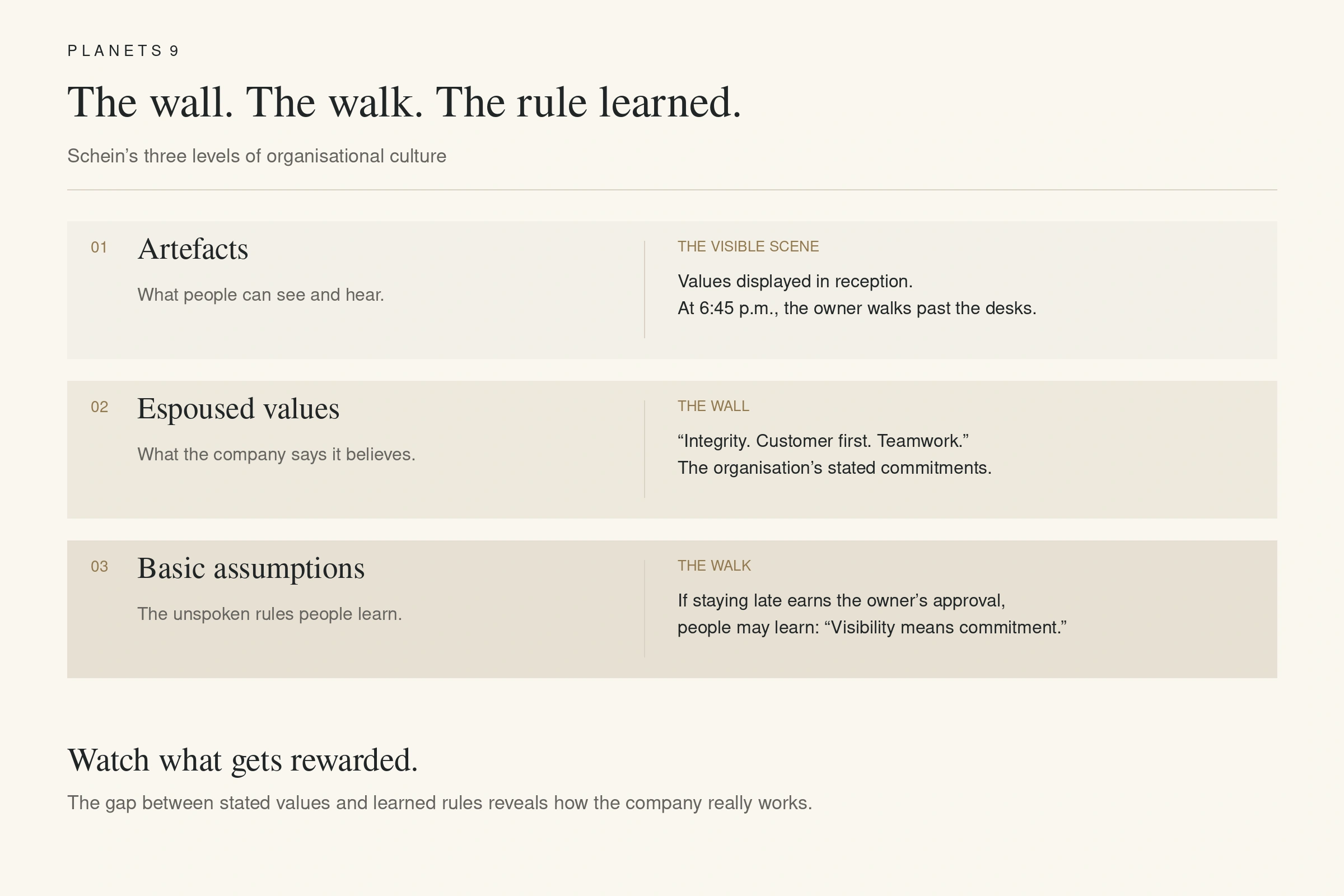
The values are on the wall in reception. Integrity, customer first, teamwork. The culture is what happens at 6.45pm when the owner walks past a desk and notices who is still there. The wall and the walk are different documents, and everyone in the company reads the second one.
Organisational culture is the set of shared assumptions, values and habits that determine how people in a company actually behave, especially when nobody is watching. Edgar Schein's model describes it in three levels: artefacts, the visible things like dress, office layout and rituals; espoused values, what the company says it believes; and basic underlying assumptions, the unspoken rules that actually drive behaviour. Culture is the third level. The first two are how a company describes itself.
This page gives Schein's three levels, the common typologies, why culture in an owner-run company is the owner's habits scaled, and what actually changes it.
Schein's three levels
Artefacts. What a visitor sees and hears in the first hour: the open or closed cabins, who eats with whom, how meetings start, what is on the walls, how people address the owner. Visible and easy to misread.
Espoused values. What the company says about itself: the values statement, the mission, what the owner says in the town hall. Sometimes true, often aspirational, occasionally the opposite of the third level.
Basic assumptions. The unspoken rules people have learned by watching what is rewarded and punished: whether it is safe to disagree with the owner, whether deadlines are real, whether the family is exempt, whether the customer or the cash comes first when they conflict, whether admitting a mistake gets help or blame. Nobody states them. Everybody follows them. This is the culture.
The gap between the second and third levels is the most reliable measure of a company's health. A company whose stated value is teamwork and whose real assumption is that the owner rewards whoever brings him information first has a culture, just not the one on the wall.
Typologies
Cameron and Quinn's competing values framework is the most used. Clan culture: collaborative, family-like, loyalty-driven, the default of most Indian SMEs in their first decade. Adhocracy: dynamic, entrepreneurial, risk-taking. Market: results-driven, competitive, target-focused. Hierarchy: structured, controlled, procedure-driven.
Most companies are a blend, and most owner-run companies are clan at the bottom and hierarchy at the top, with the owner as both patriarch and final authority. The typology is useful for one conversation: where the company is, where the next stage of growth needs it to be, and what the gap will cost the people who liked the old one. The culture stops working at scale essay is about that transition.
Culture in an owner-run company: the owner's habits, scaled
In a company built by one person, the basic assumptions are that person's habits, observed and copied by everyone who joined.
If the owner answers WhatsApp at 11pm, the assumption is that availability is loyalty. If he overrides a manager's decision in front of the team, the assumption is that authority is provisional. If he tolerates a family member's lateness, the assumption is that the rules have exceptions and everyone knows who they are. If he rewards the person who brings him news before the person who solved the problem, the assumption is that visibility beats results.
None of this was decided. It accumulated, one observed reaction at a time, and it is now the operating system of sixty people. The scaling without losing culture essay is about the founder's version of this; the point here is that the culture cannot be changed by changing the wall. It changes when the owner's observed behaviour changes, or when the company grows past the point where his behaviour is observed at all, which is when culture either becomes deliberate or dissolves.
What actually changes culture
What the owner does in the moments people watch. The reaction to the mistake, the missed deadline, the family member's exception, the manager's decision he disagrees with. Ten such moments teach more than any workshop.
Who gets promoted. The company reads every promotion as a statement of what it values. Promote the loudest, and the culture becomes loud. Promote the person who developed a team, and it becomes developmental.
Who gets tolerated. The high performer who is abusive to juniors, kept because of his numbers, defines the culture more than the values statement. The quiet accumulation of small compromises essay is about this.
What the systems reward. If the appraisal rewards individual results and the values say teamwork, the appraisal wins. Culture change that does not reach the performance system does not happen.
Structure. A wheel-shaped company produces a culture of asking. A chain-shaped one with real authority produces a culture of deciding. The organisational structure spoke covers the shapes.
Time. Schein's basic assumptions change over years, not quarters. The owner who changes his behaviour in March and expects a new culture in June has not understood the third level.
Culture and the people who carry it
Culture is transmitted by people, and some people transmit it far more than others. Every company has three or four culture carriers whose behaviour the rest calibrate against, and they are rarely the most senior. Lose one and the culture shifts; hire one who does not fit and it shifts the other way. The culture carrier problem essay covers this.
Underneath that is the fact that people relate to a given culture according to how they are built. A culture of urgency energises some and burns out others. A culture of consensus is home to some and paralysis to others. Culture fit, honestly assessed, is not about whether the person shares the values on the wall. It is about whether their operating nature matches the third level.
That is the layer under the model. The Business Pulse reads how your organisation actually runs, where decisions form and where they stall, and is the instrument for seeing the third level rather than the wall.
Questions people ask about organisational culture
What is organisational culture?
The shared assumptions, values and habits that determine how people in a company actually behave, especially when nobody is watching. In Schein's model it has three levels: artefacts, espoused values and basic underlying assumptions.
What are the types of organisational culture?
In Cameron and Quinn's framework: clan (collaborative, family-like), adhocracy (entrepreneurial, risk-taking), market (results-driven) and hierarchy (structured, procedure-driven). Most companies are a blend.
What is Schein's model of organisational culture?
Three levels: artefacts (visible things like layout and rituals), espoused values (what the company says it believes) and basic underlying assumptions (the unspoken rules that actually drive behaviour). Culture proper is the third level.
How is organisational culture formed?
Mainly from the founder's habits, observed and copied by early employees, then reinforced by who is promoted, who is tolerated and what the systems reward. It accumulates rather than being decided.
Can organisational culture be changed?
Yes, slowly, by changing what the leaders do in the moments people watch, who is promoted and tolerated, what the systems reward, and the structure. Changing the values statement alone changes nothing.
Why does culture matter for a small business?
Because it is the operating system the company runs on when the owner is not in the room, and it decides whether growth past the owner's reach produces a company or a collection of departments.
Where to go deeper
Organisational Development — the whole discipline.
Why Early Culture Doesn't Scale — the transition past a hundred people.
Scaling a Family Business Without Losing the Founder's Culture — the founder's version.
The Quiet Accumulation of Small Compromises — how culture erodes.
Employee Engagement — what the culture produces, measured.