Esprit de Corps: What Fayol Actually Said Produces It, and Why It Is Fragile in Owner-Run Companies

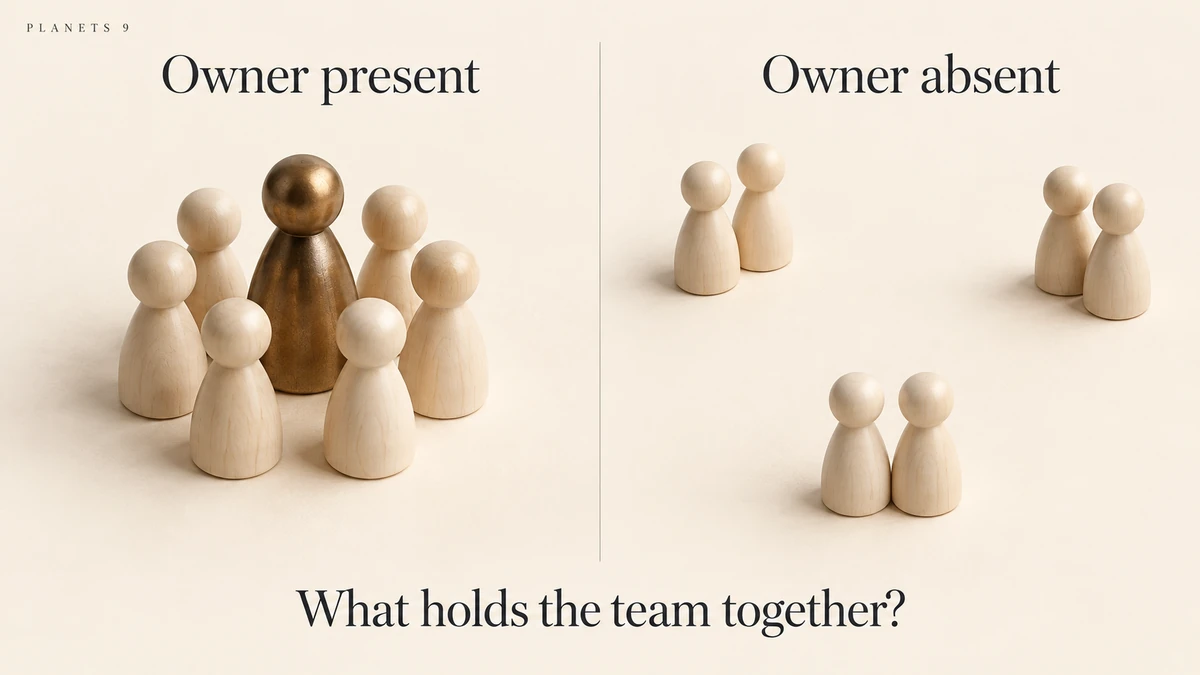
The team pulls together when the owner is in the room. When he travels, it separates into the sales camp, the accounts camp and the people who came with the family. Nobody planned this. It is simply what the company does when the one thing holding it together is absent.
Esprit de corps is Fayol's fourteenth principle: the sense of unity and shared purpose among the people of an organisation. "Union is strength." Fayol said managers should build it by avoiding two things: dividing their people, and relying on written communication where a spoken word would do. He called divide-and-rule a "grave error" for a manager, whatever its merits against an enemy. It is the principle textbooks treat as a soft close to the list, and the one that decides whether the other thirteen survive the owner's absence.
This page gives the principle, what Fayol actually said produces it, why it is fragile in owner-run companies, and what it depends on that no team-building event can supply.
What Fayol said, and did not say
The phrase is French military: the spirit of the body, the morale that makes a unit act as one. Fayol's application to companies was short and specific.
Two prohibitions. First, do not divide your people. He noted that dividing the opposition is a legitimate tactic in war and a serious mistake within one's own organisation, because a manager who sets his people against each other, whether to weaken a rival or to keep control, weakens the whole. Second, do not abuse written communication. Where an oral word would settle a matter, writing it introduces delay, misunderstanding and formality, and he had seen written exchanges turn a simple difference into a lasting quarrel.
He did not say what most modern uses of the phrase assume. He did not prescribe outings, off-sites or team-building activities. Esprit de corps, in Fayol's account, is produced by how the manager manages: by unity of command, by equity, by stability of tenure, by fair remuneration, and by not dividing. It is the result of the other principles, not a separate programme.
Why it is fragile in owner-run companies
Three patterns, each an owner behaviour rather than a team failing.
The owner is the unity. The team is united around one person. That is real esprit de corps, and it is entirely dependent on that person's presence. When he is away, there is no principle holding the team together, only the memory of him. Growth beyond one person's reach turns this from a strength into a structural risk.
Divide and rule, without meaning to. The owner plays sales against operations to keep both sharp. He tells the accounts head one thing and the sales head another. He keeps two managers uncertain of their standing so neither gets too comfortable. It is a natural way to retain control in a company that has outgrown one person's attention, and it is exactly the grave error Fayol named. Each move buys control today at the cost of the team's ability to act as one tomorrow.
The family and the rest. Equity, Fayol's eleventh principle, is the precondition for the fourteenth. When the rules apply differently to family members, every non-family employee knows which body they belong to, and it is not the same one. There are two corps, and the second has no esprit.
What produces it
Since Fayol's account makes esprit de corps a consequence, the way to build it is to remove what prevents it.
One boss per person. Dual command splits loyalties before anything else has a chance. The unity of command spoke is the first step.
Rules that apply to everyone, including the family. Not necessarily identical treatment; visibly fair treatment, which is what equity means.
Stop dividing. No triangulation, no playing managers off each other, no private version of the truth per department. The test is whether any two managers could compare what the owner told them and find it consistent.
Talk. Fayol's second prohibition, applied to WhatsApp: the manager who settles a disagreement between two heads in a five-minute conversation has done more for esprit de corps than a month of emails.
Stability. People do not commit to a body whose membership changes every quarter. The reasons good people leave are usually the failures above, showing up as attrition.
What it depends on that nobody can install
The above are the conditions. Whether the corps forms under them depends on the people in it.
Some people are joiners: they build cohesion in any room they are in, without being asked. Some are solitary and excellent, and will do the work brilliantly without ever becoming part of a body. Some divide, quietly, by temperament rather than intent, and a single one in a senior seat undoes every condition above. And the fit between people matters as much as the individuals: two capable heads whose operating natures collide will split a team between them however fair the rules are.
Most failure is not from strategy. It is from misaligned WHO.
Esprit de corps is the principle where that is most visible, because it is the one that cannot be written into a document. The conditions can be. The spirit forms or does not depending on who is in the room, and an owner who has met every condition and still has three camps has not failed at Fayol. He has a people question the principles were never designed to answer.
Questions people ask about esprit de corps
What is esprit de corps in management?
Fayol's fourteenth principle: the sense of unity and shared purpose among the people of an organisation. "Union is strength." Managers build it by not dividing their people and by preferring spoken to written communication where a word would do.
What is the meaning of esprit de corps?
A French phrase, literally "spirit of the body", meaning the morale and loyalty that make a group act as one. Originally military.
How can a manager develop esprit de corps?
By removing what prevents it: dual command, unequal treatment, divide-and-rule tactics, over-reliance on written communication, and instability. Fayol described it as a consequence of managing well rather than a separate activity.
What is an example of esprit de corps?
A team that covers for an absent colleague without being asked, resolves disagreements between departments directly, and holds the company's standard when the owner is away.
Why is esprit de corps important?
Because it is what holds an organisation together when the manager is not present. Without it, a company runs on the manager's presence and stops when he leaves the room.
Who gave the principle of esprit de corps?
Henri Fayol, as the last of his 14 principles of management, 1916.
See who is actually holding the team together
The conditions for esprit de corps are within any owner's reach. Whether it forms depends on how the people in the company actually relate to each other and to pressure, which is the part no principle can show.
The Business Pulse reads how your organisation actually runs, where decisions form, where they stall, and how much still routes through you. Fifteen minutes, answered as the owner, before the next off-site.
Where to go deeper
Principles of Management — all 14, decoded.
Unity of Command — the first condition.
Family Business Governance in India — equity between the family and the rest.
Why Your Best Employee Just Quit — what the absence of esprit de corps costs.
Culture Stops Working at Scale — the same pattern past a hundred people.