Succession Planning: The Process, Why It Fails in Indian Family Businesses, and the Three Questions Under the Name

Every owner has a succession plan. It is a name, held privately, and a date that keeps moving. The company knows the name, has opinions about it, and has never been asked. That is the state of succession planning in most Indian companies with a founder still at the desk.
Succession planning is the process of identifying the roles whose vacancy would damage the company, naming and preparing the people who could fill them, and defining how and when the handover happens, so that leadership continuity does not depend on an emergency or a single person's readiness to let go. It covers every critical role, and in an owner-run company it is dominated by one: the owner's. PwC's 2026 family business survey found 52% of Indian family businesses citing resistance from the senior generation as the biggest barrier to next-generation leadership, against 29% globally. The plan is rarely the problem. The handover is.
This page gives the process, the difference between succession and estate planning, the reasons succession fails in Indian family businesses, and the three questions underneath the name.
What succession planning covers
Four steps, for every critical role and then for the top one.
Identify the critical roles. The eight to ten positions where a sudden vacancy would hurt. The talent management spoke covers the list; the owner's own role heads it.
Assess readiness. For each role, who could hold it now, who could in one to three years with development, and where there is nobody. Ready-now, ready-later, gap.
Develop the successors. Stretch assignments, exposure to the bank and the key customers, real authority over a part of the business, reviewed. Not a title and a wait.
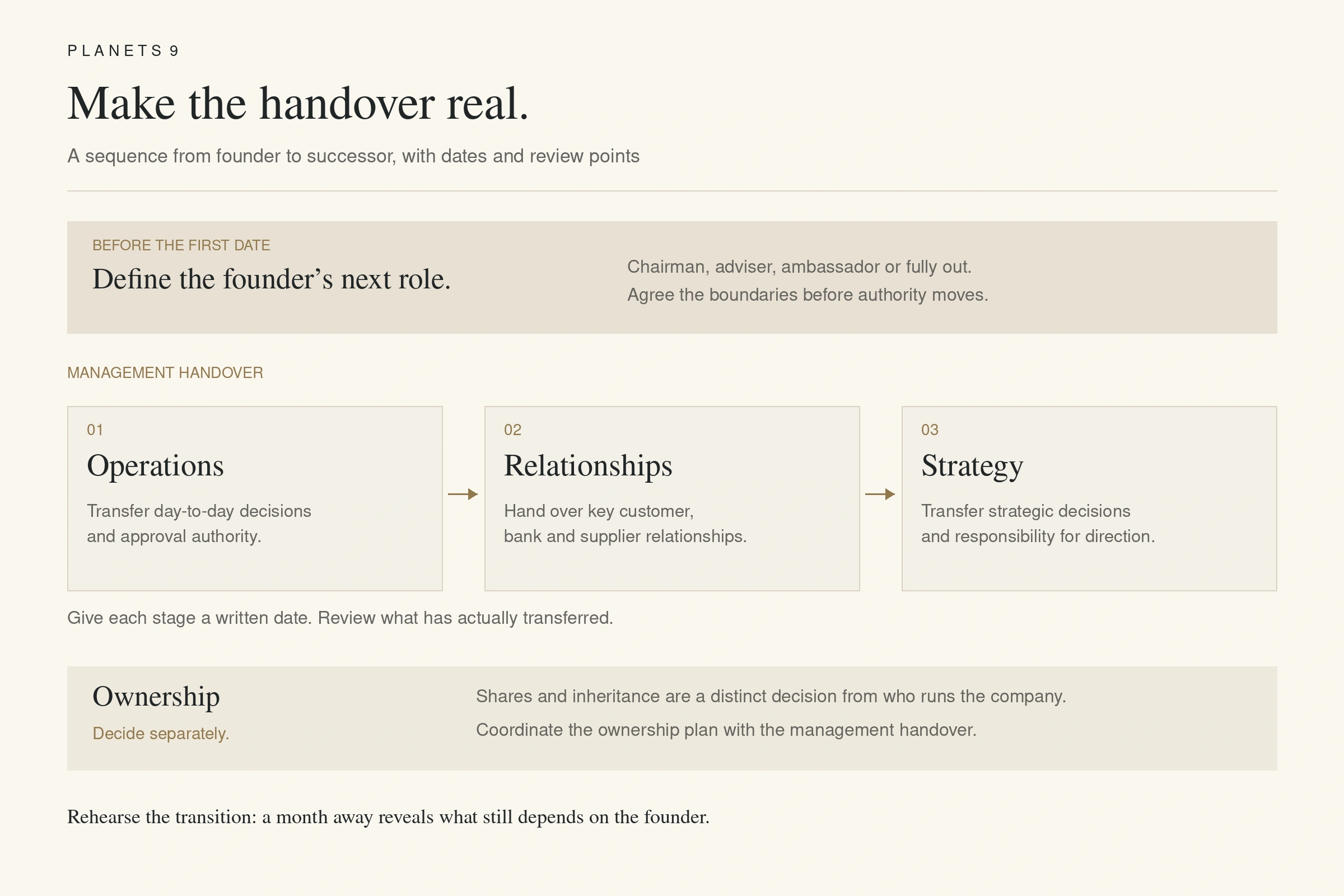
Define the handover. What transfers when, in what order: operational authority, then relationships, then strategic decisions, then ownership or title. With dates, and with what the outgoing person will do afterwards, which is the part that decides whether the dates hold.
Succession planning versus estate planning
They are confused in most family businesses, and the confusion costs. Estate planning is about ownership: who inherits shares, how the family wealth is divided, the will and the trust. Succession planning is about management: who runs the company. A son can inherit the shares and be the wrong person to run the business, and a daughter can be the right person to run it and inherit nothing under the old assumption. The family business succession essay covers why the two have to be separated and decided in the right order.
Why succession fails in Indian family businesses
The senior generation does not leave. The plan is announced, the successor is appointed, and the founder is still in the office every day, still consulted on every decision, still the person the key customers call. The company has two heads and follows the older one. The father who won't let go essay is about what is actually stuck.
The successor was chosen by birth order. The eldest son, whether or not he is built to run the company, whether or not he wants to. The next generation who doesn't want the business essay covers the second case.
The company was never made runnable by anyone else. Everything routes through the founder: relationships, knowledge, approvals, standards. Handing that to a successor hands them a hub they cannot occupy. The owner dependency guide is the prerequisite to any succession plan.
The professionals were never told. The non-family managers who run the company day to day learn the plan when it is announced, and the best of them leave because the plan tells them where the ceiling is.
The date keeps moving. Without a written sequence and a defined role for the founder afterwards, the handover is always next year. PwC found 21% of Indian family businesses had delayed leadership transition due to uncertainty, twice the global share.
The document was mistaken for the plan. A succession document is necessary. It is not the plan. The founder succession plan essay covers what the document can do and what it cannot.
A sequence that holds
Make the company runnable first. Move the authority, document the knowledge, hand over the relationships, in that order, over a year or two. The successor inherits a company, not a hub.
Choose on evidence, not position. Give each candidate, family or not, real authority over a part of the business for a year, and judge the result. The succession readiness self-test is a starting instrument.
Write the sequence with dates. Operations by this date, customer relationships by that, strategy after, ownership separately. Each step reviewed, none skipped because it felt early.
Define the founder's next role before the first date. Chairman, adviser to the successor, external ambassador, or out. Undefined, the founder drifts back into the operating role, and the company lets him.
Tell the professionals. The non-family managers should know the plan, their place in it and what the successor will need from them, before the announcement. Those who would leave will leave anyway; the rest will stay for a plan they were part of.
Rehearse. The founder takes a month away, with no calls. What breaks is the list of what has not yet been handed over.
The three questions under the name
Before WHY, there is WHO.
Succession planning, done as a process, produces a name and a date. Underneath the name are three questions the process does not ask.
Whether the successor is built to run this company: not whether they are capable or loyal or the eldest, but whether their operating nature can hold authority, carry the standard and make decisions under pressure without routing them back to the founder. Whether the founder is built to leave: some founders can move to a chairman's role and stay there; some cannot, whatever the document says, and the company needs to know which it has. And whether the company's second layer will follow the successor: a team that was united around one person does not automatically transfer to another, and the esprit de corps spoke covers why.
Those three decide the succession. The Business Pulse reads how your organisation actually runs, where decisions form, where they stall, and how much still routes through the person at the top, and is the instrument for the questions the plan leaves out.
Questions people ask about succession planning
What is succession planning?
Identifying the roles whose vacancy would damage the company, naming and preparing the people who could fill them, and defining how and when the handover happens, so that continuity does not depend on an emergency or on one person's readiness to step back.
What is the difference between succession planning and estate planning?
Estate planning decides who owns the company and the family wealth. Succession planning decides who runs the company. The two should be decided separately, and management succession first.
What are the steps in succession planning?
Identify critical roles; assess readiness (ready now, ready later, gap); develop successors through real authority and exposure; define the handover sequence with dates and the outgoing person's next role.
Why does succession planning fail in family businesses?
The senior generation does not actually leave, the successor is chosen by birth order, the company was never made runnable by anyone else, the professionals were not told, the date keeps moving, and the document is mistaken for the plan.
When should succession planning start?
At least five years before the intended handover for the top role, because making the company runnable by someone else, choosing on evidence and developing the successor each take a year or more. For other critical roles, as soon as the role is critical.
Who should be involved in succession planning?
The owner, the candidates, the non-family managers who will work under the successor, and, where ownership is also changing, the family and its advisers, kept separate from the management decision.
Where to go deeper
Organisational Development — the whole discipline.
Family Business Succession in India — why the plan is not the problem.
Founder Succession Plan — what the document can and cannot do.
Succession Readiness Assessment — the scored self-test.
Owner Dependency: Why Your Business Can't Run Without You — making the company runnable first.