Siblings in Business: Brothers, Sisters and Cousins Running One Company

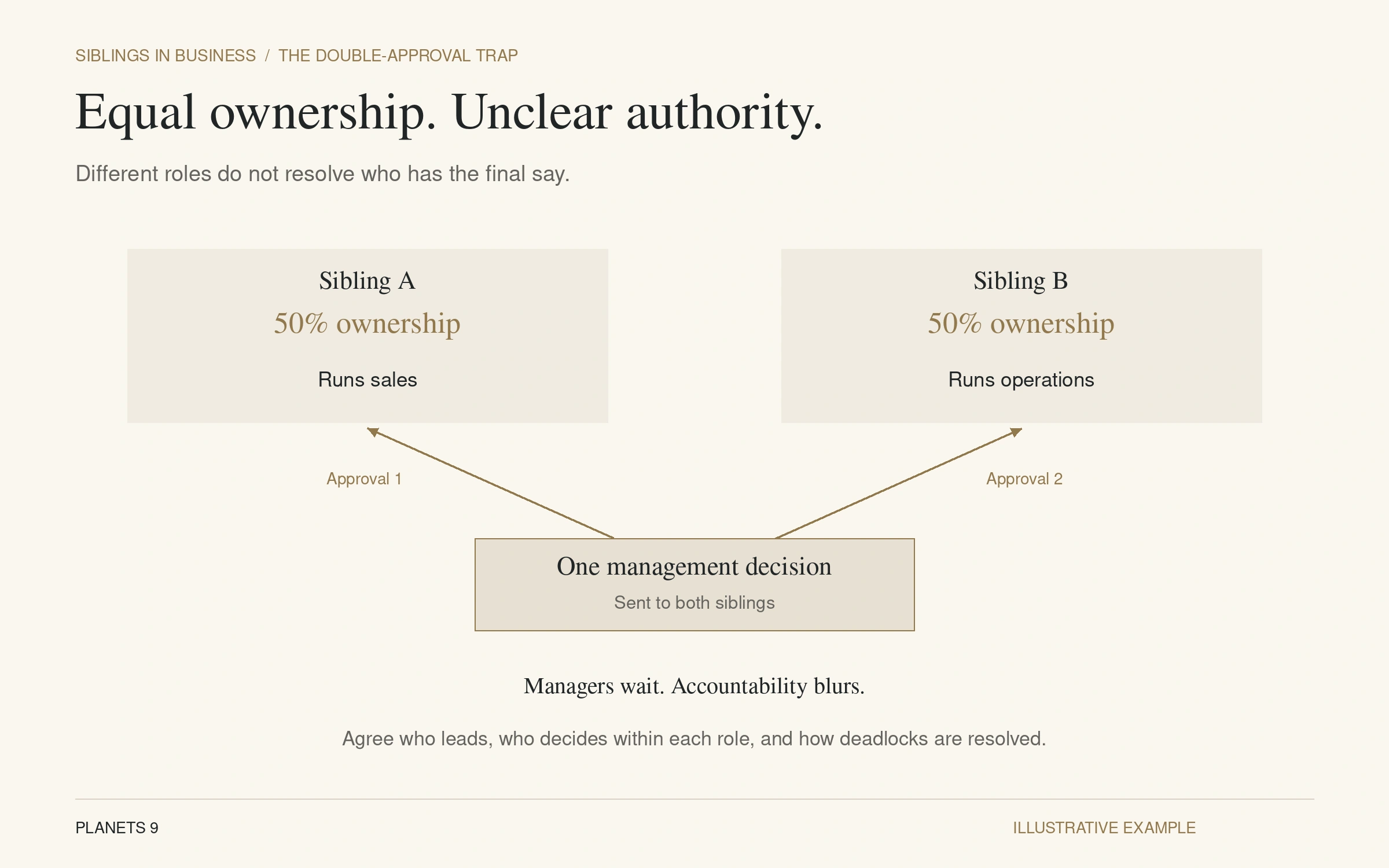
Two brothers inherited the company in equal shares. The elder runs sales because he always has. The younger runs the plant because that was what was left. Neither reports to the other, both report to their mother, and the managers have learned to get every decision approved twice.
Siblings in business are the second stage of most family companies: the founder's children, and later their cousins, owning together and dividing the running of the company between them. The stage has its own pattern of failure, distinct from the founder's and from the professionally managed company that may follow it: equal shares with unequal contribution, roles allocated by history rather than fit, no one in charge, parents as the court of appeal, and spouses and the next generation arriving with claims. It is the stage at which most Indian family businesses either split or find a structure. Indian business history is a long list of groups that divided between brothers, and a shorter list of those that worked out how not to.
This page gives the pattern, the five decisions a sibling partnership has to make, the role of the parents, the arrival of in-laws and cousins, and the question under the partnership that shares cannot answer.
Why the sibling stage is different
The founder stage has one decider. The sibling stage has two or more, usually with equal ownership, no agreed hierarchy, and a lifetime of family history that has nothing to do with the business and shapes every decision in it.
Equal shares were the founder's way of being fair. They give equal say to people with unequal roles, unequal effort and unequal capability, and they produce deadlock, because two people with 50% each cannot outvote each other. The business partner conflict essay covers the general partnership version; the sibling version adds that neither partner can be bought out without a family rupture.
Roles were allocated by history. The elder took what he had already been doing when the father was alive. The younger took what remained. Nobody asked what either was built for, and the meritocracy spoke covers why the question is so rarely asked inside families.
There is no one in charge. The founder held the company together by being the founder. Siblings hold equal moral authority and unequal everything else, and the managers below them route decisions to whichever brother is likely to say yes.
The five decisions
A sibling partnership that lasts has made these five, in writing, usually after a crisis that taught them why.
Who leads. One sibling is managing director, with the authority the role carries, and the others are directors, department heads or owners only. Equal ownership does not mean equal management; the unity of command spoke explains what happens to a company with two heads. The choice is made on evidence, ideally with an outside voice, and the succession planning spoke covers making it.
Who does what. Each sibling in management holds a defined seat, with the authority the matrix gives it, reporting to the managing director like any other head. A sibling's seat is not a territory; it is a role, and it can change.
How siblings are paid. Salary for the role, at the rate the role pays. Dividends for ownership, in proportion to shares. The two are separated, in writing, so that the sibling who works harder is paid for it and the sibling who owns more is paid for that, and neither subsidises the other unknowingly.
How disagreements are decided. A forum, a rule, and a tie-breaker. The board for business matters, the family council for family matters, and an independent director or trusted outsider whose vote breaks a deadlock. Not the mother. Not the dinner table.
How a sibling exits. From management, from ownership, or both. At what valuation, by what process, over what period. Written before anyone wants to, because the sibling who wants to leave has already decided the terms in his head, and the one who wants to stay has decided differently. The family business governance essay covers the constitution these five decisions live in.
The parents
The surviving parent is the sibling partnership's court of appeal, and it is the worst possible one. She decides on family grounds, she cannot be seen to prefer one child, and her rulings hold only as long as she is alive.
The founder, if alive, is worse, because he has views on the business as well as the family. The father who won't let go essay covers the founder who has handed over and not left; in a sibling partnership he becomes the third principal that every manager learns to route through.
The rule that works is that the parents are owners, or chair, or neither, and that the siblings resolve business disputes in the business's forum. Getting the parents to accept the rule is usually the elder sibling's job, and it is the first test of whether he can lead.
In-laws and cousins
The sibling stage does not stay a sibling stage. Spouses arrive with opinions, and sometimes with roles. Children arrive, and the hiring family members spoke covers the rules for their entry. Each sibling's branch begins to count what the other branch takes.
The cousin stage that follows has more owners, fewer seats, and a family that no longer eats together. The groups that reach it intact did three things at the sibling stage: separated ownership from management, so that a cousin can own without working; wrote the family employment policy before the cousins were old enough to test it; and built the family council, so that the branches have somewhere to disagree that is not the boardroom.
When to split
Sometimes the right answer is the one Indian business history is full of. Two siblings built for different things, running two businesses that happen to share a name, are often better apart than deadlocked together.
A split done early, on agreed terms, with the businesses divided along lines that make operational sense, has preserved more family relationships than partnerships forced to continue. A split done late, in court, after the managers have left and the customers have noticed, has destroyed both.
The test is whether the siblings can make the five decisions above. If they can, the partnership can work. If two years of trying have not produced them, the decision they are avoiding is the split, and making it while the relationship survives is better than having it made for them.
The two people in the partnership
Everything above is structure, and structure is necessary. Underneath it are two or three specific people, whose operating natures either fit together or do not. Two decisive siblings will fight over every decision however clear the matrix. A decisive one and a deferential one will produce a partnership that is really a proprietorship with a silent partner, and resentment that arrives ten years later. Two who both avoid conflict will produce a company in which nothing is decided and the managers run it by default. The business partnership that starts well and breaks down essay covers the general case; siblings add a lifetime of history to it.
That is the layer under the partnership. The Business Pulse reads how your organisation actually runs, where decisions form, where they stall, and how much still routes through you, and is the instrument for seeing whether the two people who own this company can actually run it together, before the answer arrives in court.
Questions people ask about siblings in business
How do siblings run a family business together?
By making five decisions in writing: who leads, who holds which defined seat, how salary is separated from dividends, how disagreements are decided and by whom, and how a sibling exits. Equal ownership does not mean equal management.
Should siblings have equal shares in a family business?
Equal shares are fair on paper and produce deadlock in practice, because two people with 50% each cannot outvote each other. If shares are equal, the tie-breaker, the forum and the exit terms have to be written, and management authority has to be unequal.
How should siblings be paid in a family business?
Salary for the role, at market rate, and dividends for ownership, in proportion to shares. The two are kept separate so that the sibling who works more is paid for the work and the sibling who owns more is paid for the ownership.
Why do family businesses split between brothers?
Equal shares with no tie-breaker, roles allocated by history rather than fit, no agreed leader, parents as the court of appeal, and no written exit. Most Indian business splits at the second generation trace to one or more of these.
Who should be the head of a family business among siblings?
The sibling best built for the seat, chosen on evidence, with the others as directors, department heads or owners only. Birth order is the traditional answer and the karta model enforces it; it is not a reliable one.
When should a family business be divided?
When two years of trying have not produced the five decisions, and the siblings are built for different things. A split made early, on agreed terms, along operationally sensible lines, preserves more than a partnership forced to continue.
Where to go deeper
Nepotism: Meaning, Examples, and the Family-Business Version — the pillar.
Family Business — the stages, from founder to cousin consortium.
Joint Hindu Family Business — the karta model siblings inherit.
Business Partner Conflict — the general partnership version.
Family Business Governance in India — the constitution the five decisions live in.